
Japan tourism adds overtourism curbs as spring crowds surge
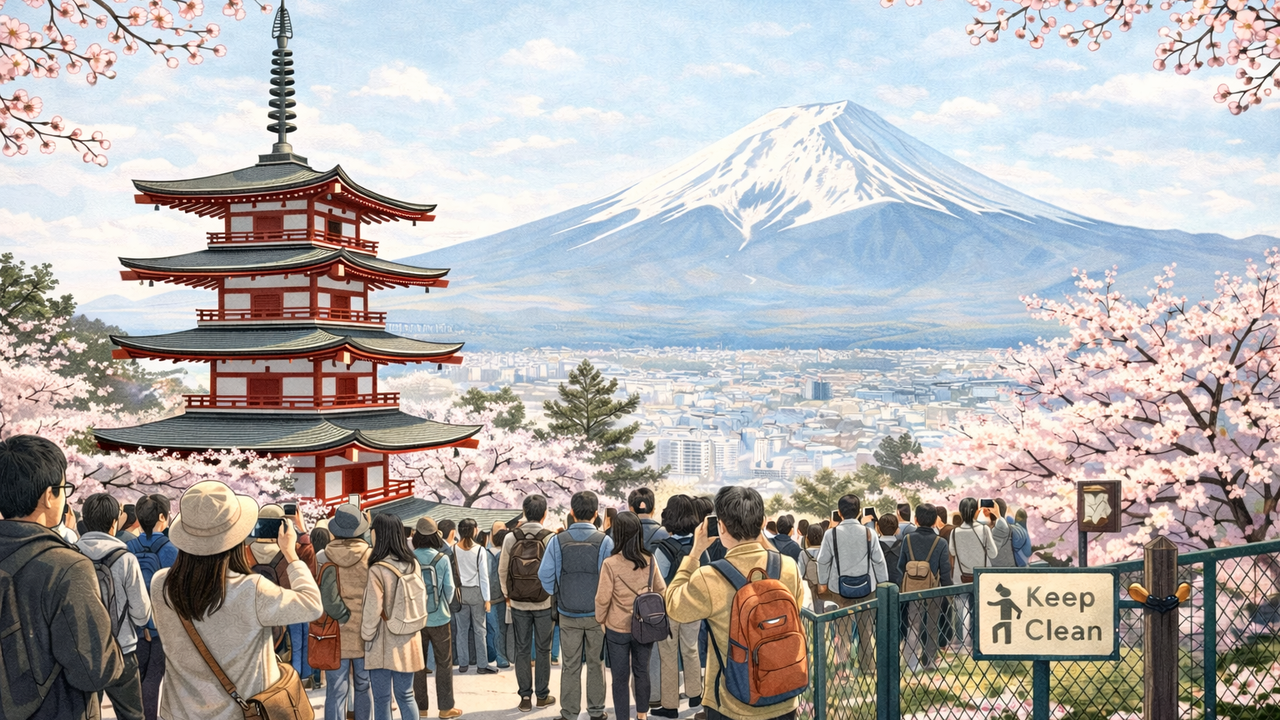
Japan tourism is entering a stricter spring after the government approved a new five-year national tourism plan on March 27, 2026, adding fresh overtourism targets just as cherry blossom crowds swelled around Mount Fuji and Kyoto. The move signals a shift in how Japan intends to manage record visitor demand: keep growing inbound travel, but put more emphasis on local crowd control, regional dispersal and rules aimed at protecting daily life in popular destinations.
Official figures show why the issue has become harder to ignore. Japan welcomed a record 42,683,600 foreign visitors in 2025, while inbound travel spending reached 9.45 trillion yen, also a high. Momentum has carried into 2026. February brought 3.4667 million arrivals, a record for that month, with strong gains from South Korea and Taiwan offsetting a sharp drop in visitors from China.
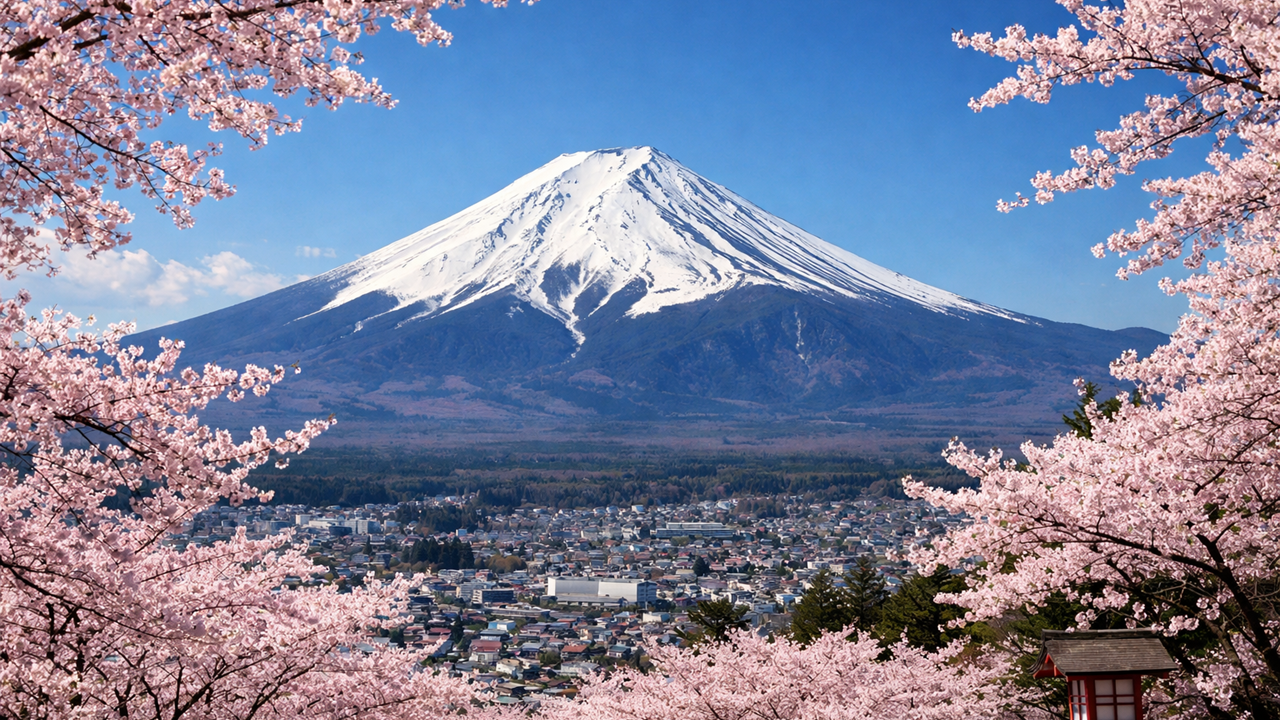
The pressure has been especially visible in Fujiyoshida, the Yamanashi city known for the postcard view of Mount Fuji framed by a red pagoda and cherry blossoms. On February 3, city officials said they would not hold the 2026 Arakurayama Sengen Park Cherry Blossom Festival, a spring event that had drawn about 200,000 visitors a year. The city said overtourism had gone beyond what local infrastructure and neighborhoods could absorb, citing persistent traffic congestion, trespassing, litter, sanitation problems and safety concerns for children using school routes. Even without the festival, large crowds were still gathering at the site on April 8 as visitors sought the same image made famous on social media.
Kyoto, another major spring hotspot, has already moved to raise the cost of staying in the city. From March 1, 2026, its accommodation tax increased across most price bands, rising as high as 10,000 yen per person per night for stays costing 100,000 yen or more. City tourism officials have framed the change as part of a broader effort to fund sustainable tourism, ease pressure on transport and public services, and encourage more responsible travel behavior during peak periods.
At the national level, the new plan covers fiscal 2026 through 2030 and keeps the country’s long-standing goals of 60 million inbound visitors and 15 trillion yen in visitor spending by 2030. What changed is the addition of a specific overtourism benchmark. The government wants the number of regions actively balancing visitor growth with residents’ quality of life to rise to 100 by 2030, up from 47 in 2025. The policy also puts more emphasis on steering repeat visitors toward regional destinations outside the traditional Tokyo-Kyoto-Osaka corridor.
For travelers, the message is not that Japan is closing its doors. Demand remains strong, and the country still wants more visitors over the long term. But the spring of 2026 is making clear that Japan tourism is entering a more managed phase, one in which iconic cherry blossom locations, historic city centers and Mount Fuji viewpoints are likely to come with more fees, more local rules and a stronger push to spread travel beyond the country’s most crowded landmarks.























 Harry Negron
Harry Negron is the CEO of Jivaro, a writer, and an entrepreneur with a background in science, technology, and digital publishing. He holds a B.S. in Microbiology and Mathematics and a Ph.D. in Genetics, with a specialization in biomedical sciences. His work spans finance, science, health, gaming, and technology, and his projects include free apps, automation tools, and large-scale search utilities. Originally from Puerto Rico and based in Japan since 2018, he brings an international perspective to Jivaro’s content, research, and tools.