
Japanese Yen Hits 160 Per Dollar for First Time Since 2024
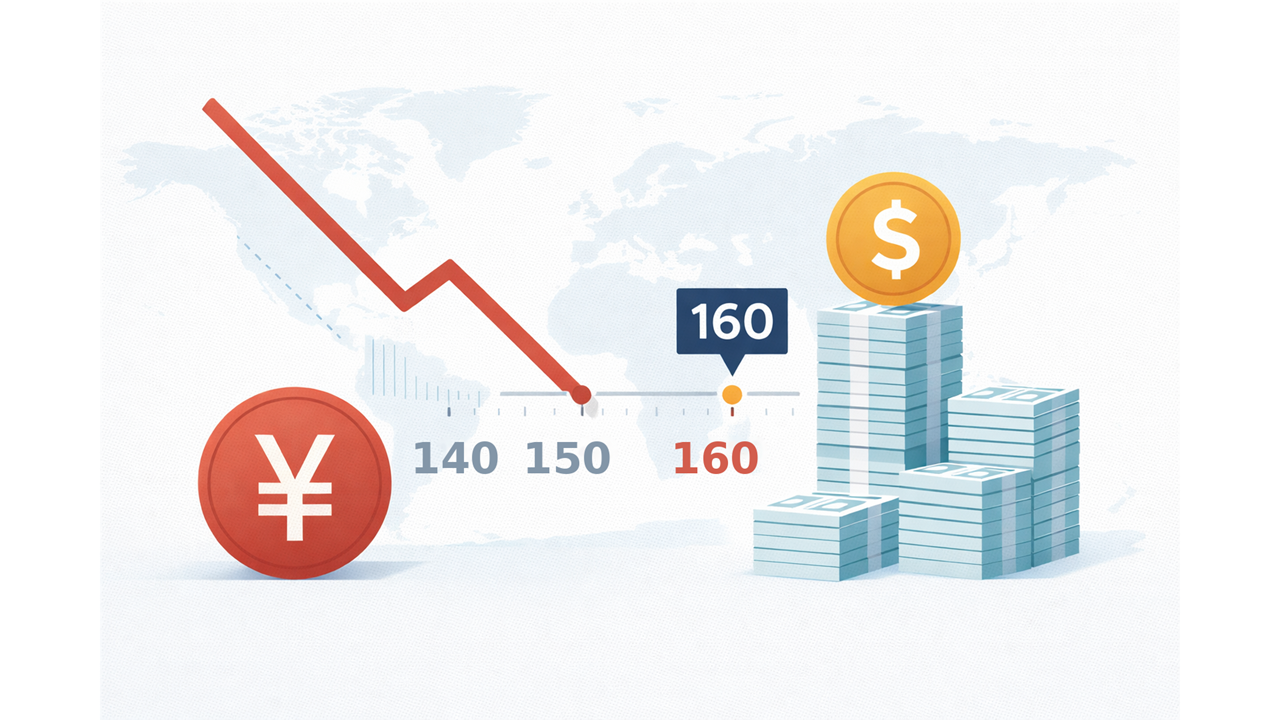
The Japanese yen 160 per dollar threshold was breached in New York trading on March 27, 2026, sending Japan’s currency to its weakest level since July 2024 and reviving fears of another government intervention. The move marked the first time in about 20 months that the yen traded beyond 160 against the U.S. dollar, underscoring how quickly external shocks and policy divergence can reshape currency markets.
The yen’s slide came as investors piled into the dollar as a safe haven amid intensifying Middle East tensions and higher oil prices. Rising energy costs are especially damaging for Japan because the country depends heavily on imported fuel, and a weaker currency amplifies that burden by making those imports more expensive in yen terms.
Bank of Japan daily market rates still showed the dollar at 159.94-96 yen at 5 p.m. JST on March 27, suggesting the decisive break above 160 came later in overseas trading. By New York hours, market reports showed the dollar rising to around 160.35 yen, the weakest level for the Japanese currency since authorities stepped into the market in July 2024.
The renewed slide immediately put Tokyo back on intervention watch. Finance Minister Satsuki Katayama said after a cabinet meeting on March 27 that the government would respond firmly, including with bold measures, if speculative and oil-linked currency moves threatened the economy. Japanese officials have repeatedly signaled in recent weeks that they are prepared to act against what they see as excessive volatility in foreign exchange markets.
Pressure on the yen has been building even as the Bank of Japan moves gradually away from the ultra-loose policy stance that defined much of the past decade. The central bank left its short-term policy rate unchanged at 0.75% on March 19 but warned that the Middle East conflict and higher crude prices could intensify inflation. Governor Kazuo Ueda also kept alive expectations for further rate increases, yet the yen remained vulnerable as U.S. yields and safe-haven demand continued to support the dollar.
The exchange-rate move carries political and economic consequences inside Japan. A weaker yen can help exporters and raise the value of overseas earnings when converted back into yen, but it also pushes up the cost of fuel, food and other imported goods for households and smaller businesses. That trade-off has become harder for policymakers to manage as inflation remains politically sensitive and the country faces another external energy shock.
For currency markets, the symbolic importance of 160 remains high because it recalls the levels that triggered intervention episodes in 2024. For Japan’s government and the Bank of Japan, the latest break suggests that verbal warnings alone may struggle to slow the yen if geopolitical tension, oil prices and broad dollar strength continue to move in the same direction.



























 Harry Negron
Harry Negron is the CEO of Jivaro, a writer, and an entrepreneur with a background in science, technology, and digital publishing. He holds a B.S. in Microbiology and Mathematics and a Ph.D. in Genetics, with a specialization in biomedical sciences. His work spans finance, science, health, gaming, and technology, and his projects include free apps, automation tools, and large-scale search utilities. Originally from Puerto Rico and based in Japan since 2018, he brings an international perspective to Jivaro’s content, research, and tools.