Getting published starts with a smaller decision than most beginners expect: what kind of publication are you trying to earn?
A personal essay, a research article, a guest post, a literary magazine piece, a traditional book, and a self-published guide all have different rules. If you treat them the same way, you waste time. If you choose the right lane first, the process gets less mysterious.
This guide is for people asking how to get published without already having an agent, a university lab, a large audience, or a long portfolio. The answer is not “just write more.” It is: pick a realistic publication path, build a piece that fits that path, submit it correctly, revise when needed, and keep a simple tracking system so one rejection does not end the project.
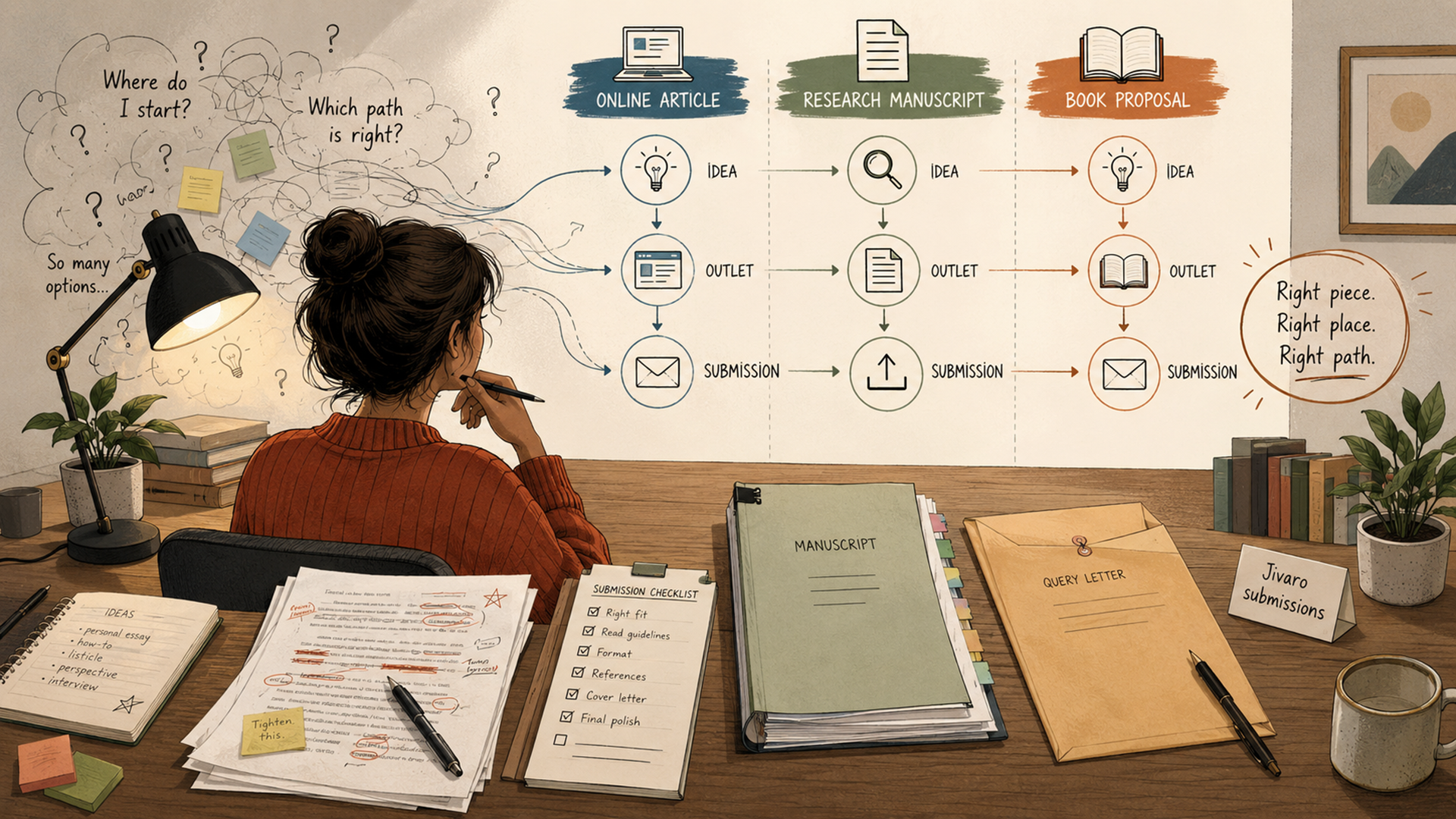
Most beginner publishing guides focus on one route. Book-publishing guides often emphasize agents, manuscripts, and the traditional publishing chain; Penguin’s guide to getting published notes that most major publishers do not accept manuscripts directly from writers, so a literary agent is often a key step for traditional book publishing. Online writing guides tend to focus on getting past fear and writing a narrow first article. Academic publishing guides focus on journal fit, cover letters, technical checks, editor review, peer review, and final decisions; Springer Nature’s article-publishing guide lays out that staged process clearly.
A stronger beginner plan borrows from all three: write something focused, match it to the right gatekeeper, and submit in the format that gatekeeper actually wants.
What “getting published” really means
Getting published can mean different things:
| Publishing path | What “published” means | Beginner-friendly? | Main gatekeeper |
|---|---|---|---|
| Personal blog or newsletter | You post it yourself. | High | You |
| Online publication or guest article | An editor accepts and publishes your article. | Medium | Editor |
| Literary magazine | A magazine accepts your short story, poem, essay, or creative nonfiction. | Medium | Editor / readers |
| Research journal | A journal accepts a scholarly manuscript after screening, review, and revision. | Medium to hard | Editor / reviewers |
| Jivaro Journal research submission | Jivaro screens research-driven manuscripts in its stated scope. | Medium | Editorial screening / possible peer review |
| Traditional book | An agent and publisher take on your manuscript or proposal. | Hard | Agent / publisher |
| Self-published book | You publish through a platform or service yourself. | High access, hard to sell | You / marketplace |
The mistake is asking, “How do I get published?” before asking, “Published where, for whom, and in what format?”
A 900-word opinion article needs a sharp hook and a clear editor fit. A research manuscript needs a question, method, evidence, references, disclosures, and journal alignment. A novel needs a finished manuscript before querying agents. A nonfiction book may need a proposal, sample chapters, platform, and market positioning.
Choose the right publication lane before writing
Before drafting, decide which lane matches the piece you can realistically finish.
| If you have… | Best first publication path | Why |
|---|---|---|
| A practical idea or personal lesson | Blog, newsletter, guest post, or online publication | You can publish or pitch quickly and learn from response. |
| A strong argument about work, tech, culture, finance, or health | Essay, commentary, or niche publication | Editors want a clear angle, not a broad topic dump. |
| A research question and sources | Review article, methods note, or research manuscript | The format rewards structure and evidence. |
| A class paper or thesis chapter | Student journal, undergraduate journal, or revised research article | You already have material to refine. |
| A short story, poem, or memoir piece | Literary magazine | Smaller creative pieces are easier to submit than a whole book. |
| A completed novel | Literary agent query or small press submission | Traditional fiction usually needs a full, revised manuscript. |
| A nonfiction book idea | Proposal, platform-building, or article-first strategy | Publishing shorter pieces can test the idea before a book pitch. |
| A useful how-to or niche guide | Self-published ebook or long-form web guide | You control the format, but distribution is your responsibility. |
Beginners often aim too large. “I want to publish a book” may be real, but the first useful step might be a 1,200-word article that proves the idea has a reader. “I want to publish research” may be real, but the first useful step may be a narrow review paper instead of an original study that requires permissions, funding, and data access.
Start with the smallest publishable idea
A publishable idea is not the biggest topic you can imagine. It is the smallest useful claim you can support.
Weak idea: “AI is changing education.”
Better idea: “College instructors need clearer policies for AI-assisted feedback because students often cannot tell where editing ends and authorship begins.”
Weak idea: “Remote work is good.”
Better idea: “Remote workers should choose jobs by workday fit, not job title, because call volume, autonomy, deadlines, and communication style shape whether the job is sustainable.”
Weak research idea: “Social media affects mental health.”
Better research idea: “A review of how 2023–2026 studies measure loneliness among university students who use short-form video platforms daily.”
A small idea is not a small ambition. Editors and reviewers like pieces with edges. A narrow piece can be judged. A vague piece cannot.
Use this test:
| Question | Bad answer | Better answer |
|---|---|---|
| Who is this for? | Everyone interested in writing. | Beginners trying to publish their first article or research manuscript. |
| What is the exact claim? | Publishing is hard. | Publishing gets easier when you choose the right lane before drafting. |
| What evidence or experience supports it? | I have thoughts. | Examples, source links, journal guidelines, editor expectations, and a concrete workflow. |
| Where could it fit? | Anywhere. | Jivaro Journal, a niche blog, a literary magazine, a student journal, or a specific agent list. |
| What should the reader do next? | Keep writing. | Pick one outlet, study three published examples, prepare the correct submission package. |
If you cannot answer those five questions, do not draft yet. Narrow the idea first.
Study the outlet before you pitch or submit
Editors can usually tell when a beginner has not read the publication. The submission may be well written and still wrong for the outlet.
Before submitting anywhere, read at least three recently published pieces from that outlet. Look for average length, headline style, level of evidence, tone, audience, structure, author bios, citation or source style, and whether pieces are reported, personal, analytical, scholarly, or practical.
For research journals, this step is even more important. Springer Nature tells authors to follow the target journal’s submission guidelines, handle permissions, check data reproducibility, follow plagiarism and ethics policies, write a cover letter, submit through the journal homepage, and expect technical checks and editor or peer review.
For books, study agents and publishers instead of only studying books you like. Penguin’s guide emphasizes that agents often have different submission requirements and that researching each agent helps the submission feel deliberately matched rather than mass-mailed.
For Jivaro, the fit question is specific. Jivaro Journal’s submission page says manuscripts should be research-driven, complete, clearly prepared, and aligned with the journal’s scope and publication standards; current scope areas include finance, science and health, and technology.
How to get published as a beginner: the practical workflow
The simplest beginner workflow looks like this:
- Choose one publication lane.
- Choose one target outlet.
- Read three to five examples from that outlet.
- Build a narrow idea that fits.
- Draft in the format the outlet expects.
- Revise once for clarity and once for fit.
- Prepare the submission package.
- Submit cleanly.
- Track the response.
- Revise, resubmit, or send it elsewhere.
The workflow matters because motivation is unreliable. A beginner who depends on excitement will quit after the first rejection. A beginner with a system can treat rejection as a routing problem: wrong outlet, weak pitch, unclear idea, underdeveloped evidence, or timing.
Build the right submission package
Different publication lanes need different materials.
| Publication type | What you usually need | What beginners often miss |
|---|---|---|
| Online article | Finished draft or short pitch, headline, brief bio | The article must match the publication’s existing style and audience. |
| Guest post | Pitch, outline, author credibility, draft if requested | The pitch should explain reader value, not just your interest. |
| Literary magazine | Finished creative piece, cover note, bio | Follow genre, word count, formatting, and simultaneous-submission rules. |
| Research journal | Manuscript, abstract, keywords, references, cover letter, declarations | Ethics, data availability, AI use, conflicts, and journal fit. |
| Jivaro Journal | Manuscript, title page, abstract, keywords, cover letter, declarations, relevant files | Scope fit, policy readiness, clean file names, and complete materials. |
| Literary agent | Query letter, synopsis, sample pages, full manuscript for fiction | Querying before the manuscript is revised. |
| Nonfiction book proposal | Proposal, chapter outline, sample chapter, market case, author platform | Treating an idea as enough without a clear reader and market. |
| Self-published book | Finished manuscript, editing, cover, formatting, metadata, launch plan | Publishing is easy; getting readers is the hard part. |
Jivaro’s author guidelines are useful as a model even if you are not submitting to Jivaro. They ask authors to prepare the manuscript, title page, declarations, references, figures, tables, and supporting materials needed for editorial screening and double-anonymous peer review. That kind of checklist thinking prevents sloppy submissions.
If you want to publish research, build around the journal
Research publishing is not just “write an essay with citations.” A publishable research manuscript needs a clear contribution.
| Research format | What it contributes | Beginner example |
|---|---|---|
| Research article | New analysis, evidence, data, model, method, or argument | An analysis of public data on housing costs in remote-work cities. |
| Review article | Structured synthesis of existing literature | A review of studies on AI feedback tools in college writing courses. |
| Short report | Focused finding or pilot result | A compact report on a small dataset or early result. |
| Case study | Deep analysis of one system, event, workflow, or population | A case study of a local clinic’s patient reminder system. |
| Methods note | Reproducible workflow or process | A workflow for anonymizing interview data before AI-assisted coding. |
| Perspective piece | Evidence-aware argument | A reasoned argument about AI disclosure standards in student research. |
Jivaro’s article-type guidance says the article type should match what the manuscript actually does: investigate, synthesize, report, analyze, explain, apply, or argue. That is a good rule everywhere. Do not force a weak project into the most prestigious-sounding format. A clean short report is better than a padded research article.
For Jivaro specifically, the submission page says authors should confirm scope fit, prepare required files, and review authorship, conflicts, funding, ethics, data availability, AI use, and publication-policy expectations before submitting.
Jivaro is accepting research manuscript submissions
Jivaro is currently accepting research manuscript submissions through Jivaro Journal. The submission page is for new manuscripts, revised submissions, and author inquiries, and it lists Research Articles and Review Articles as the current submission article types, with finance, science and health, and technology as scope areas.
That does not mean every submission will be accepted or reviewed externally. Jivaro’s peer-review page says submissions may be declined during administrative screening or editorial assessment before external peer review, and manuscripts selected for external review undergo double-anonymous peer review by at least two independent reviewers.
A beginner-friendly way to think about Jivaro fit:
| Good Jivaro fit | Poor Jivaro fit |
|---|---|
| A research-driven technology, finance, science, or health manuscript. | A promotional article about a product. |
| A structured review with a defined question and source method. | A casual opinion piece with no evidence base. |
| A methods note, applied research insight, or focused analysis with clear value. | A general blog post submitted as if it were research. |
| A manuscript with complete references, declarations, and scope fit. | A draft missing abstract, keywords, author details, or disclosures. |
If the piece is a practical blog, it belongs in a blog workflow. If it is research-driven and prepared as a manuscript, Jivaro Journal’s submission page is the right place to check fit.
Use a workflow, not a blank page
The hardest part for many beginners is not writing sentences. It is moving from “I have an idea” to “I have a piece that belongs somewhere.”
For research-style work, Jivaro’s Research Gap-to-Paper Workflow Kit is designed to help users move from a vague idea, assigned topic, pile of PDFs, dataset, or partial draft into a structured research-paper workflow. The product page describes a step-by-step path from idea to topic narrowing, literature gathering, source extraction, synthesis, gap validation, research question, study design, analysis support, outline, draft, abstract, tables, figures, and citation or claim verification.
Use that kind of tool for organization, not for faking expertise. A workflow can help you ask better questions, organize sources, and check claims. It cannot make a weak idea publishable by itself. It also cannot replace a professor, supervisor, ethics board, statistician, reviewer, or editor.
Write the pitch or cover letter like a working editor will read it
A pitch is not a diary entry. A cover letter is not a place to explain your entire life. Both should answer the editor’s practical questions quickly.
For an online article pitch:
Subject: Pitch: [Clear working headline]

Hi [Editor Name],

I’m pitching a [word count] article for [publication name] about [specific angle].

The piece argues that [one-sentence claim]. It would be useful for your readers because [reader value], and it fits your recent coverage of [specific article or theme].

Planned structure:
- [Section or point 1]
- [Section or point 2]
- [Section or point 3]

I’m [one sentence of relevant background]. I can send a full draft or revise the angle if another version would fit better.

Best,
[Name]
For a research manuscript cover letter:
Dear Editor,

Please consider our manuscript, “[Title],” for [journal name]. The manuscript is a [article type] examining [research question or topic].

The main contribution is [one or two sentences explaining what the paper adds]. We believe it fits the journal because [scope fit and audience].

The manuscript has not been submitted elsewhere. Required declarations are included, including conflicts of interest, funding, ethics approval or exemption where applicable, data availability, and AI use disclosure where applicable.

Thank you for your consideration.

Sincerely,
[Corresponding author]
For a literary agent query:
Subject: Query: [Title], [Genre], [Word Count]

Dear [Agent Name],

I’m seeking representation for [Title], a [word count] [genre/category] about [one-sentence hook].

When [protagonist] wants [goal], [central conflict] forces them to [stakes or choice]. The book will appeal to readers of [comparison title] and [comparison title] because [specific shared appeal].

I’m querying you because [specific reason based on agent interests or list]. [Brief relevant bio.]

Thank you for your time and consideration.

Best,
[Name]
The pattern is the same: name the piece, explain the fit, show the value, and stop before the message becomes work to read.
Handle AI use without damaging trust
AI can help with brainstorming, outlining, restructuring, summarizing notes, and checking whether a pitch is clear. It should not invent sources, fabricate data, create fake quotations, or hide uncertainty.
For research and medical publishing, authorship and accountability rules matter. ICMJE says all listed authors should meet all four authorship criteria and be able to take public responsibility for the work; contributors who do not meet the criteria should be acknowledged instead. ICMJE’s AI guidance also says humans must ensure proper attribution and that AI-generated material is not used as a primary source.
A practical rule: use AI for process help, not for authority. If a sentence depends on a source, check the source yourself. If a claim depends on data, inspect the data yourself. If a journal or publication requires AI disclosure, disclose it.
Avoid scams, vanity traps, and predatory journals
Beginners are vulnerable because they want validation. That makes them easy targets for bad publishers, fake contests, and journals that promise fast acceptance without real review.
| Red flag | Why it matters |
|---|---|
| Guaranteed publication | Serious editors and journals reject work that does not fit. |
| Acceptance in a few days for a research paper | Real review usually takes time. |
| Hidden fees | You should know costs before acceptance or publication. |
| Fake prestige language | “International,” “leading,” or “impact” claims need proof. |
| No clear editor or publisher identity | You need to know who is handling your work. |
| Poorly explained peer review | Legitimate journals explain how review works. |
| Publisher asks for money before explaining services | Be careful with pay-to-publish offers. |
| Journal name mimics a respected journal | Similar names can be used to confuse authors. |
Think. Check. Submit. offers a checklist for assessing whether a journal is trusted, including whether the journal is known, whether the publisher can be identified and contacted, whether peer review is explained, whether archiving and indexing are clear, and whether fees are transparent. COPE also warns about predatory publishing behavior, including hidden fees and weak or absent peer review.
For book publishing, be careful with anyone who flatters you and quickly asks for money. Paying for editing, coaching, design, or formatting can be legitimate when you understand the service. Paying a “publisher” because they guarantee your book will be published is a different thing. Penguin’s guide gives a blunt warning: do not pay a publisher to publish your work, and be careful with packages marketed to self-publishing authors.
Track submissions like a professional
A beginner who submits one piece and waits emotionally is going to suffer. Use a tracker.
| Field | Example |
|---|---|
| Piece title | “AI Feedback Policies in College Writing Courses” |
| Publication lane | Research review article |
| Target outlet | Jivaro Journal |
| Submission URL | Jivaro submit page |
| Status | Drafting / submitted / rejected / revise / accepted |
| Date submitted | June 15, 2026 |
| Response window | 8–12 weeks if stated; otherwise check guidelines |
| Notes | Needs abstract, keywords, AI disclosure, reference cleanup |
| Next outlet | Backup journal or publication |
| Revision needed | Narrow introduction; add source method table |
Track everything: where you submitted, what version you sent, what the guidelines required, when you followed up, what feedback arrived, and where the piece should go next.
This turns publishing from a confidence test into a workflow.
What to do after rejection
Rejection is normal. It can mean the piece is weak, but it can also mean the piece was wrong for that outlet, the timing was wrong, the editor had a similar piece, the journal scope was off, or the reviewer wanted a different framing.
| Rejection type | What it probably means | What to do |
|---|---|---|
| No explanation | The outlet may be overloaded or not interested. | Send elsewhere after checking fit. |
| “Not for us” | Scope, tone, or audience mismatch. | Revise the pitch or choose a better outlet. |
| Detailed editorial feedback | The piece has potential but needs work. | Revise carefully and consider resubmission if invited. |
| Research review criticism | Method, evidence, claims, or structure need repair. | Make a response plan before rewriting. |
Do not rewrite everything immediately. First, identify whether the problem is idea, fit, evidence, structure, or polish. A fit problem needs a new outlet. An evidence problem needs more research. A structure problem needs a better outline. A polish problem needs editing.
A realistic 30-day beginner plan
| Day range | Task | Output |
|---|---|---|
| Days 1–2 | Choose one lane and one target outlet. | Publication path and outlet name. |
| Days 3–5 | Read three to five published examples. | Notes on length, structure, tone, and evidence. |
| Days 6–7 | Narrow the idea. | One-sentence claim and working title. |
| Days 8–14 | Draft the piece. | Full draft or manuscript skeleton. |
| Days 15–17 | Revise for structure. | Cleaner outline and section flow. |
| Days 18–20 | Revise for evidence and fit. | Stronger support and outlet alignment. |
| Days 21–23 | Prepare submission materials. | Pitch, cover letter, bio, files, declarations if needed. |
| Days 24–25 | Proof and format. | Final submission-ready version. |
| Day 26 | Submit. | Logged submission. |
| Days 27–30 | Prepare backup plan. | Two next outlets and revision notes. |
This plan will not get every piece accepted in 30 days. It will get you out of vague preparation and into the publishing process.
FAQ
How can I get published with no experience?
Start with a smaller publication lane: a blog post, guest article, student journal, niche publication, literary magazine, or focused research review. Read the outlet first, write something narrow, and submit cleanly. Experience grows fastest when you finish and submit real pieces.
Do I need a literary agent to get published?
For many major traditional publishers, yes, especially for fiction and many trade books. Penguin’s publishing guide says most major publishers do not accept manuscripts directly from writers, which is why literary agents are often part of the process. Smaller presses, magazines, journals, blogs, and self-publishing routes may not require an agent.
Can I publish an article before writing a book?
Yes. For many nonfiction writers, publishing articles first is a smart way to test ideas, build credibility, and learn what readers respond to. A strong article can become part of a larger platform or book proposal later.
Does Jivaro accept publications?
Jivaro accepts research manuscript submissions through Jivaro Journal. The submission page lists Research Articles and Review Articles, scope areas including finance, science and health, and technology, and a staged process involving preparation, submission, editorial screening, possible peer review, decision, revision, and production.
What should I submit to Jivaro?
Submit research-driven work that fits the journal’s scope and is prepared like a manuscript, not a casual blog post. Check Jivaro’s author guidelines, article type expectations, required files, declarations, and submission page before sending anything.
Can AI help me get published?
AI can help you brainstorm, outline, organize sources, identify weak structure, and clean up a pitch. It should not invent evidence, fabricate citations, hide uncertainty, or replace human verification. For research manuscripts, disclose AI use when required and verify every source and claim.
How do I know if a journal is legitimate?
Use a checklist such as Think. Check. Submit. Look for a known journal, identifiable publisher, clear peer-review process, transparent fees, indexing or archiving information, and realistic timelines.
What is the easiest way to get published?
The easiest access is self-publishing or posting on your own blog. The easiest editorial acceptance is usually a narrow, useful article submitted to a publication that clearly fits it. The best first step is not always the easiest platform; it is the path that teaches you how real publication standards work.
Sources and useful resources
- Penguin: How to Get Published
- Springer Nature: Publish an Article
- Jivaro Journal: Submit Manuscript
- Jivaro Journal: Author Guidelines
- Jivaro: Research Gap-to-Paper Workflow Kit
- Think. Check. Submit.: Journals Checklist
- COPE: Predatory Behaviour in Publication Ethics
- ICMJE: Defining the Role of Authors and Contributors
Getting published is not one gate. It is a set of gates. The beginner advantage is that you do not have to open all of them at once. Pick one lane, study the outlet, build a piece with edges, submit it cleanly, and keep moving when the first answer is no.