Quick Answer: How Peer Review Works
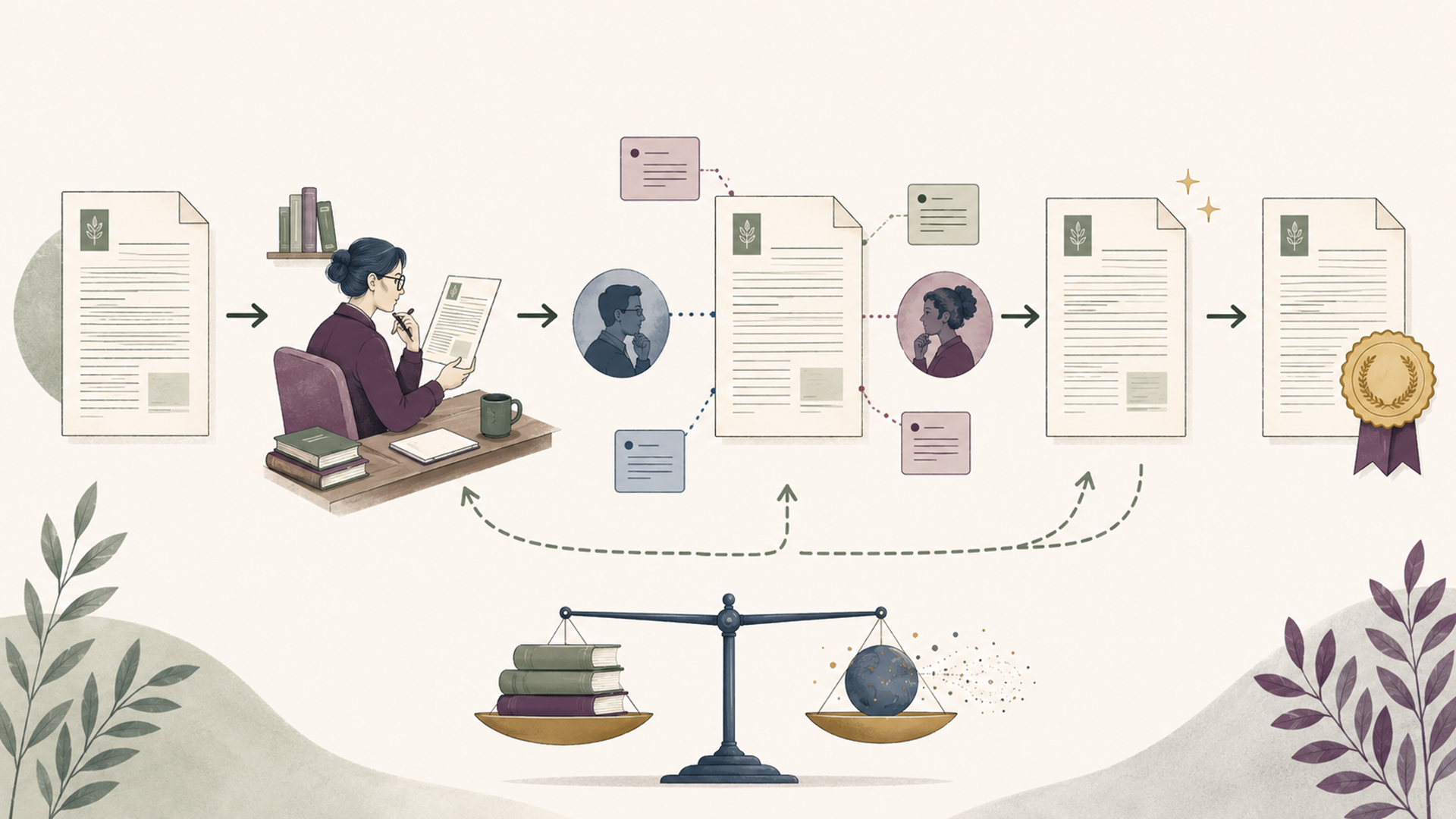
Peer review works by sending a scholarly manuscript through editorial screening, expert evaluation, revision, and final editorial decision-making. In most journal workflows, editors first decide whether the submission fits the journal and meets basic quality, ethics, and formatting standards. If it passes that stage, the manuscript may be sent to qualified reviewers who evaluate the research question, methods, evidence, interpretation, originality, and clarity. Reviewers advise the editor, but the editor or journal makes the final decision.[1]
The main review models differ in who can see whose identity. In single-anonymous peer review, reviewers know who the authors are, but authors do not know who the reviewers are. In double anonymous peer review, author and reviewer identities are masked from each other during review when feasible. In open peer review, identities, review reports, or both may be made visible, depending on the journal’s model. In editorial review, editors evaluate the submission directly, either before external review or as the primary review route for article types that do not require outside reviewers.[3]
The most useful way to understand peer review is to see it as a filter and improvement process—not as proof. A peer-reviewed article has passed a journal’s review system, but peer review cannot guarantee that every claim is true, every limitation has been found, or every dataset is error-free. Good peer review improves manuscripts and helps editors make decisions; it does not replace careful reading, replication, transparent methods, or post-publication scrutiny.[8]
What Peer Review Is—and What It Is Not
Peer review is the evaluation of scholarly work by people with relevant expertise. In journal publishing, that usually means reviewers assess a manuscript before publication and send confidential comments to the editor, the authors, or both. The goal is to help the journal decide whether the work is credible, useful, ethical, sufficiently clear, and appropriate for the journal’s audience.[1]
Peer review is not the same as fact-checking every sentence, auditing all raw data, rerunning every statistical model, or certifying a paper as permanently correct. Reviewers usually work from the materials provided by the authors and the journal. They may identify missing controls, unsupported claims, unclear methods, statistical concerns, ethical gaps, or overstatement, but they cannot see what is not disclosed. That is why strong publication systems also rely on data availability statements, conflict disclosures, corrections, retractions, and reader scrutiny after publication.[2]
This distinction matters for both authors and readers. Authors should treat peer review as a serious test of clarity and evidence, not as an adversarial ritual. Readers should treat “peer reviewed” as a credibility signal, not as the final word. A peer-reviewed paper still needs to be judged by study design, evidence quality, transparency, limitations, conflicts of interest, and how it fits with the wider literature.
Plain-English definition: peer review is a structured critique of a manuscript by editors and qualified reviewers before, during, or after publication. Its job is to improve research communication and support editorial decisions. Its job is not to make science infallible.
The Peer Review Process Step by Step
Journals vary in timing, article types, reviewer numbers, and decision categories, but many peer-review systems follow a similar path. The process usually begins before reviewers are invited, because editors must first decide whether the submission belongs in the journal and is ready for evaluation. The International Committee of Medical Journal Editors describes peer review as a process that assists editors in deciding which manuscripts are suitable for publication and can also help authors improve their manuscripts.[1]
| Stage | What happens | What authors should understand | What readers should understand |
|---|---|---|---|
| Submission | The author sends the manuscript, title page, declarations, figures, tables, references, and supporting files through the journal’s submission route. | Incomplete files, missing disclosures, weak anonymization, or unclear article type can delay or stop review. | A submitted manuscript is not yet peer reviewed and should not be treated as accepted evidence. |
| Administrative screening | Journal staff or editors check file completeness, formatting, declarations, plagiarism concerns, scope, and policy requirements. | This is not a judgment of scientific importance alone; it also checks whether the package is review-ready. | Screening protects reviewer time and helps journals avoid sending unready submissions to reviewers. |
| Editorial assessment | An editor evaluates fit, contribution, clarity, ethical readiness, methodological plausibility, and whether external review is worthwhile. | A desk rejection can happen before peer review if the manuscript is out of scope or not strong enough for the journal. | Not every rejected manuscript has been rejected by external reviewers; many are declined editorially. |
| Reviewer invitation | The editor invites reviewers with relevant expertise and without known disqualifying conflicts of interest. | Reviewer selection can take time because experts may decline, be unavailable, or have conflicts. | Reviewer independence and expertise are central to the credibility of the process. |
| External review | Reviewers evaluate the manuscript and submit comments, confidential notes, and sometimes a recommendation. | Reviewer recommendations are advisory; they do not automatically determine the decision. | Review quality can vary, which is why editors must interpret reviewer comments rather than simply count votes. |
| Editorial decision | The editor decides whether to reject, request major revision, request minor revision, accept, or seek additional review. | A revise decision is not acceptance. Authors must respond clearly and traceably. | The final decision reflects editorial judgment, not just reviewer preference. |
| Revision and final checks | Authors revise the manuscript, respond point by point, update declarations, and may undergo further review. | A strong response explains what changed, where it changed, and why any requested change was not made. | Accepted papers may still change during copyediting, proofing, and publication preparation. |
Many misunderstandings come from treating peer review as a single event. In reality, it is a workflow with different checkpoints. A manuscript can be rejected before external review, revised more than once, sent to additional reviewers, accepted after substantial changes, or declined after a serious review if the editor decides the concerns remain unresolved.
Single, Double, Open, and Editorial Review Compared
Review models are mostly about identity, transparency, and where judgment sits. No model is perfect. Single-anonymous review can make conflict checking easier because reviewers see author identities, but it can also expose the process to prestige, institution, nationality, or personal-network bias. Double anonymous review can reduce some identity-based influence, but anonymity may be imperfect in specialized fields where methods, citations, datasets, or preprints make authors guessable. Open review can make the process more transparent, but may change reviewer behavior or make some reviewers less willing to participate.[4]
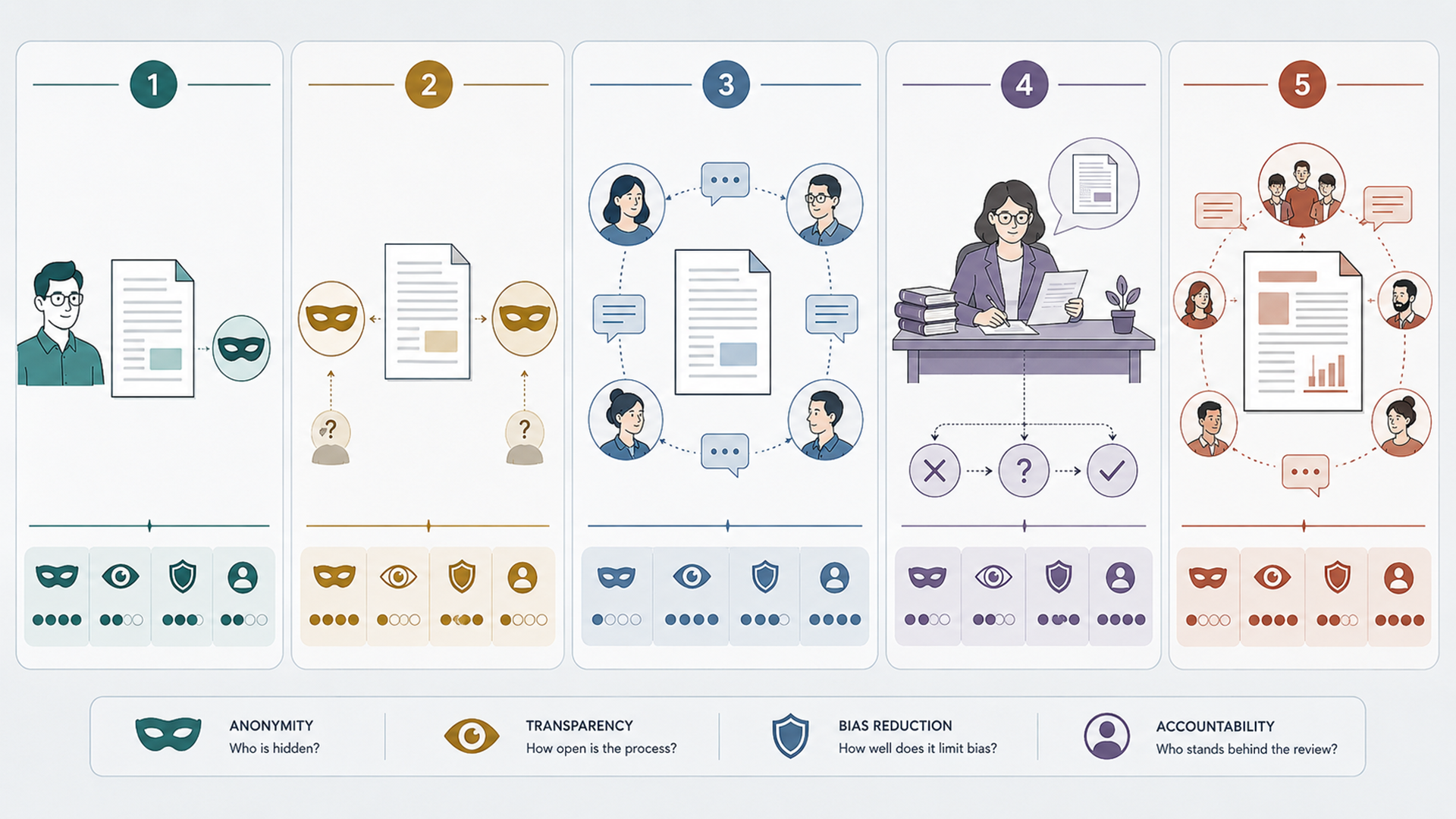
| Review model | Who is visible? | Main strengths | Main limitations |
|---|---|---|---|
| Single-anonymous review | Reviewers usually know the authors’ identities; authors usually do not know reviewer identities. | Common, familiar, and easier for reviewers and editors to check conflicts, prior work, and field context. | May allow prestige, institutional, country, gender, seniority, or network bias to influence review judgments. |
| Double anonymous peer review | Author and reviewer identities are masked from each other during review when feasible. | Designed to reduce identity-based bias and improve perceived fairness, especially for early-career researchers and less prestigious institutions. | Anonymity can be incomplete if the field is small, the manuscript uses recognizable datasets, or the work is already public as a preprint. |
| Open peer review | Reviewer names, author names, review reports, author responses, or public comments may be visible depending on the journal. | Can increase transparency, accountability, reviewer credit, and reader insight into how the article changed. | There is no single definition; openness may reduce candor, increase reviewer reluctance, or create social pressure in sensitive fields. |
| Editorial review | Editors evaluate the work directly; external reviewers may not be used. | Efficient for scope checks, invited pieces, commentaries, corrections, editorials, or submissions outside journal fit. | Can become opaque if standards are not clear, because fewer independent expert voices may be involved. |
| Post-publication review | Readers, experts, journals, or public platforms comment after publication; identity rules vary. | Allows the scholarly record to be tested after publication through critique, replication, corrections, and debate. | Can be uneven, slow, informal, or poorly moderated; it should complement, not replace, editorial responsibility. |
The terminology itself is evolving. Many publishers and standards groups increasingly use “single-anonymous” and “double-anonymous” instead of “single-blind” and “double-blind.” The meaning is the same in most contexts, but the newer wording is clearer and avoids metaphorical language that some readers may find imprecise.[3]
Why Double Anonymous Peer Review Exists
Double anonymous peer review exists because reviewers can be influenced, consciously or unconsciously, by information that is not part of the manuscript’s scientific argument. Author names, institutional prestige, country, seniority, previous reputation, and professional networks can shape expectations before the evidence is evaluated. A double anonymous model attempts to keep the review focused on the manuscript rather than the people behind it.
The evidence on anonymization is mixed but meaningful. A controlled experiment at the WSDM 2017 conference found that reviewers in the single-anonymous condition were more likely than double-anonymous reviewers to recommend acceptance for papers from famous authors and top institutions.[7] Broader reviews of peer-review bias also describe recurring concerns around author identity, institutional prestige, gender, nationality, language, and disciplinary networks.[6]
Double anonymous review is not magic. Reviewers may infer author identity from self-citations, datasets, clinical trial registrations, preprints, writing style, specialized methods, or research communities that are small enough for work to be recognizable. Editors may also need author identities to check conflicts of interest, funding, ethics approvals, and prior dissemination. The best version of double anonymous review is therefore practical rather than theatrical: authors prepare anonymized files carefully, reviewers avoid identity speculation, and editors manage conflicts with the information they need.
What Reviewers Actually Check
Reviewers are usually asked to evaluate whether the manuscript’s question is clear, whether the methods can answer that question, whether the evidence supports the conclusions, and whether the work contributes something useful to the field. In science and health publishing, this often includes study design, statistical reasoning, data transparency, ethical approvals, conflicts of interest, reporting completeness, limitations, and whether claims are overstated.[2]
A strong review does not simply say “accept” or “reject.” It explains the manuscript’s major strengths, identifies problems that affect interpretation, separates essential revisions from preferences, and gives the editor enough reasoning to make a decision. The best reviews are rigorous without being hostile. They are specific enough for authors to respond and transparent enough for editors to judge whether a concern is methodological, ethical, conceptual, or merely stylistic.
| Review area | Core question | Examples of serious concerns | What should not dominate the review |
|---|---|---|---|
| Research question | Is the question clear, relevant, and answerable? | Unclear aim, vague hypothesis, mismatch between question and evidence. | Preference for a different but unrelated research question. |
| Methods | Can the design, data, and analysis support the claim? | Missing controls, inappropriate comparison, weak sampling, unclear statistical plan. | Demanding unnecessary methods that do not affect the main claim. |
| Evidence | Do the results support the conclusions? | Overinterpretation, unsupported causal claims, selective reporting, missing uncertainty. | Rejecting a paper because results are not exciting enough if the article type values rigor over novelty. |
| Ethics and transparency | Are approvals, consent, conflicts, data availability, and reporting limits clear? | Missing ethics statement, undisclosed funding role, unclear data access, image concerns. | Treating disclosure as a formality rather than part of the research record. |
| Clarity | Can readers follow the argument and evaluate the work? | Confusing structure, undefined terms, missing figure labels, incomplete references. | Minor style preferences that do not change interpretation. |
Confidentiality is also central. Reviewers should not use unpublished manuscript information for personal, professional, commercial, or competitive advantage, and they should disclose conflicts that could compromise fair evaluation.[2] As AI tools become more common in research workflows, journals are increasingly treating automated assistance as a confidentiality and accountability issue. For example, Jivaro Journal states that AI tools must not compromise manuscript confidentiality and should not replace expert review, methodological judgment, ethical assessment, or editorial responsibility.[10]
Editorial Review: Where Judgment Belongs
Editorial review is sometimes misunderstood as a weaker version of peer review. It can be weak if it is vague or arbitrary, but in a well-run journal it is a necessary layer of judgment. Editors decide whether a manuscript fits the journal, whether it is complete enough to review, whether the subject requires specialized external expertise, and whether reviewer comments justify revision, rejection, or acceptance.
Editors also protect the process from mechanical decision-making. If two reviewers disagree, the editor must decide whether the disagreement is about evidence, interpretation, scope, novelty, writing, or personal preference. If a reviewer makes a strong criticism without support, the editor should not treat it as automatically decisive. If a reviewer recommends acceptance but misses an ethical or statistical problem, the editor remains responsible for the publication decision.[1]
For readers, this means a peer-reviewed paper is partly a product of editorial standards. Two journals may use the same general review model but apply very different thresholds for novelty, methodological detail, ethics documentation, data transparency, or revision. That is why transparent journal policies matter. A trustworthy journal should make its review model, conflict rules, correction policies, and author requirements visible.
Open Peer Review and Post-Publication Review
Open peer review is not one single model. A systematic review by Tony Ross-Hellauer found that “open peer review” has been used to describe several practices, including open identities, open reports, open participation, open interaction, open pre-review manuscripts, open final-version commenting, and open platforms.[4] In practical terms, a journal may publish reviewer reports while keeping reviewer identities anonymous, reveal reviewer names only after publication, allow public commenting, or combine several open elements.
The strongest argument for open review is transparency. Readers can see what reviewers questioned, how authors responded, and how the article changed. Reviewers may also receive visible credit for serious intellectual labor. The strongest concern is candor. Reviewers may soften criticism if their names are visible, especially when evaluating senior researchers, direct competitors, or controversial work. Openness can also create risks for early-career reviewers if the culture around disagreement is not healthy.
Post-publication review is different. It happens after the article is public and may include letters, formal comments, replication attempts, methodological critiques, corrections, expressions of concern, or retractions. It is especially important because no pre-publication review system can catch everything. Science is cumulative; the publication date is not the end of evaluation.
How Authors Should Prepare for Peer Review
Authors cannot control whether reviewers agree with them, but they can make the manuscript easier to evaluate. The first task is alignment: the title, abstract, research question, methods, results, discussion, limitations, and claims should all point in the same direction. A reviewer should not have to guess what the study tried to answer or where the evidence for a claim appears.
For double anonymous peer review, authors should separate identity information from the review file when the journal asks for it. Jivaro Journal’s author guidelines, for example, instruct authors to prepare an anonymized main manuscript and a separate title page containing author metadata, funding information, acknowledgments, conflicts, ethics summaries, data availability summaries, and AI-use disclosure where applicable.[11]
Authors should also make the evidence trail easy to follow. That means clear references, readable tables and figures, complete methods, transparent limitations, and a data availability statement when applicable. If the study involves people, animals, identifiable data, clinical records, biological materials, sensitive information, AI systems, or dual-use concerns, the manuscript should explain the relevant ethics approvals, consent pathway, privacy safeguards, and limitations before review begins.[12]
Author checklist before submission: define the article type, anonymize the review file if required, separate the title page, include declarations, check references, make figures and tables readable, disclose conflicts and funding, explain data availability, and ensure the conclusions do not go beyond the evidence.
How Readers Should Interpret Peer-Reviewed Work
For readers, “peer reviewed” should raise confidence somewhat, but it should not end critical thinking. A peer-reviewed article may still be wrong, incomplete, underpowered, poorly reported, affected by conflicts of interest, or contradicted by later evidence. A single paper is rarely the best basis for a strong conclusion, especially in health, public policy, psychology, nutrition, economics, and fast-moving technical fields.
Readers should ask a few practical questions. What type of article is it: original research, review article, editorial, commentary, case report, methods paper, or preprint? Was the claim tested directly, or is it inferred from indirect evidence? Are the methods clear enough to evaluate? Are conflicts and funding disclosed? Is the dataset available or reasonably explained? Do the conclusions match the results? Has other work replicated or challenged the finding?
Readers should also be alert to journals that advertise peer review without transparent standards. Predatory or deceptive journals may use false or misleading information, weak editorial practices, poor transparency, and aggressive solicitation while claiming scholarly legitimacy.[9] A credible journal does not need to promise easy acceptance, guaranteed publication, unrealistically fast review, or publication decisions for sale.
How Jivaro Journal Fits This Framework
Jivaro Journal describes itself as an open-access journal for research across finance, science and health, and technology. Its public research page states that its review model is double-anonymous when submissions are selected for external review, and that research articles and review articles are currently considered article types.[13]
The Jivaro Journal peer review process page states that research articles and review articles selected for external review undergo double-anonymous peer review by at least two independent reviewers, while final decisions remain editorial decisions.[10] This is an important distinction: reviewer comments inform the decision, but the journal’s editorial leadership remains responsible for accepting, declining, or requesting revision.
Jivaro’s policy pages also make clear that review depends on more than reviewer comments alone. The publication policies page addresses open access, copyright, licensing, editorial independence, peer review, authorship, conflicts, research ethics, data integrity, AI use, misconduct, corrections, appeals, and complaints.[14] For authors, that means review-readiness is not only about the main manuscript; it also includes disclosures, ethics, transparency, and file preparation.
Bottom Line
Peer review is a structured editorial process that helps journals evaluate and improve scholarly work. It usually includes screening, reviewer selection, expert critique, revision, and final editorial decision-making. The four major models—single-anonymous, double-anonymous, open, and editorial review—differ in identity visibility, transparency, speed, accountability, and vulnerability to bias.
Double anonymous peer review is designed to reduce identity-based influence, but it cannot remove all bias or guarantee perfect anonymity. Open peer review can improve transparency, but it changes incentives and may affect reviewer candor. Editorial review is essential because reviewers advise; editors decide. Post-publication review matters because published research continues to be tested after it appears.
The healthiest view is balanced: peer review is valuable, imperfect, and necessary. Authors should prepare manuscripts so reviewers can evaluate them fairly. Readers should treat peer review as one credibility signal among many, alongside study design, transparency, reproducibility, conflicts of interest, and the wider body of evidence.
FAQ
What does peer reviewed mean?
Peer reviewed means a manuscript has been evaluated by editors and, in many cases, external experts before publication. It does not mean the article is guaranteed to be correct. It means the work passed a journal’s review and editorial decision process.
Is double anonymous peer review the same as double blind peer review?
In most publishing contexts, yes. “Double anonymous peer review” is the clearer term for a process in which author and reviewer identities are masked from each other during review when feasible. Many people still use “double blind peer review” to mean the same thing.
Is single-anonymous peer review biased?
Single-anonymous review is not automatically biased, but it can expose the process to identity-based influence because reviewers can see author names and affiliations. Studies and reviews have raised concerns about prestige, institution, gender, nationality, and network effects in peer review.[6]
Is open peer review better?
Open peer review is more transparent, but not always better for every field or article type. It can make review reports visible and give reviewers credit, but it may also reduce reviewer willingness or candor in sensitive settings. The details matter because “open peer review” can mean several different practices.[4]
Can a paper be rejected before peer review?
Yes. Many journals use editorial screening before external review. A manuscript may be declined because it is out of scope, incomplete, methodologically weak, insufficiently novel for that journal, ethically unclear, or not ready for review.
Does peer review catch fraud?
Sometimes, but it is not designed primarily as a fraud-detection system. Reviewers may identify suspicious inconsistencies, image concerns, missing data, or implausible claims, but journals also need data policies, ethics checks, corrections, retractions, and post-publication scrutiny.
References
- International Committee of Medical Journal Editors. (n.d.). Recommendations for the conduct, reporting, editing, and publication of scholarly work in medical journals.
- Committee on Publication Ethics. (2017). COPE ethical guidelines for peer reviewers.
- National Information Standards Organization. (2021). Peer review terminology (NISO RP-32-2021).
- Ross-Hellauer, T. (2017). What is open peer review? A systematic review. F1000Research, 6, 588.
- Tennant, J. P., Dugan, J. M., Graziotin, D., Jacques, D. C., Waldner, F., Mietchen, D., Elkhatib, Y., Collister, L. B., Pikas, C. K., Crick, T., Masuzzo, P., Caravaggi, A., Berg, D. R., Niemeyer, K. E., Ross-Hellauer, T., Mannheimer, S., Rigling, L., Katz, D. S., Greshake Tzovaras, B., ... Colomb, J. (2017). A multi-disciplinary perspective on emergent and future innovations in peer review. F1000Research, 6, 1151.
- Lee, C. J., Sugimoto, C. R., Zhang, G., & Cronin, B. (2013). Bias in peer review. Journal of the American Society for Information Science and Technology, 64(1), 2–17.
- Tomkins, A., Zhang, M., & Heavlin, W. D. (2017). Reviewer bias in single- versus double-blind peer review. Proceedings of the National Academy of Sciences, 114(48), 12708–12713.
- Bruce, R., Chauvin, A., Trinquart, L., Ravaud, P., & Boutron, I. (2016). Impact of interventions to improve the quality of peer review of biomedical journals: A systematic review and meta-analysis. BMC Medicine, 14, 85.
- Grudniewicz, A., Moher, D., Cobey, K. D., Bryson, G. L., Cukier, S., Allen, K., Ardern, C., Balcom, L., Barros, T., Berger, M., Ciro, J. B., Cugusi, L., Donaldson, M. R., Egger, M., Graham, I. D., Hodgkinson, M., Khan, K. M., Mabizela, M., Manca, A., ... Lalu, M. M. (2019). Predatory journals: No definition, no defence. Nature, 576, 210–212.
- Jivaro Journal. (2026). Peer review process.
- Jivaro Journal. (2026). Author guidelines.
- Jivaro Journal. (2026). Research ethics.
- Jivaro Journal. (2026). Jivaro Journal: Peer-reviewed research.
- Jivaro Journal. (2026). Publication policies.