
Credit Card Payoff Calculator Guide: Fixed, Minimum, Extra Payments
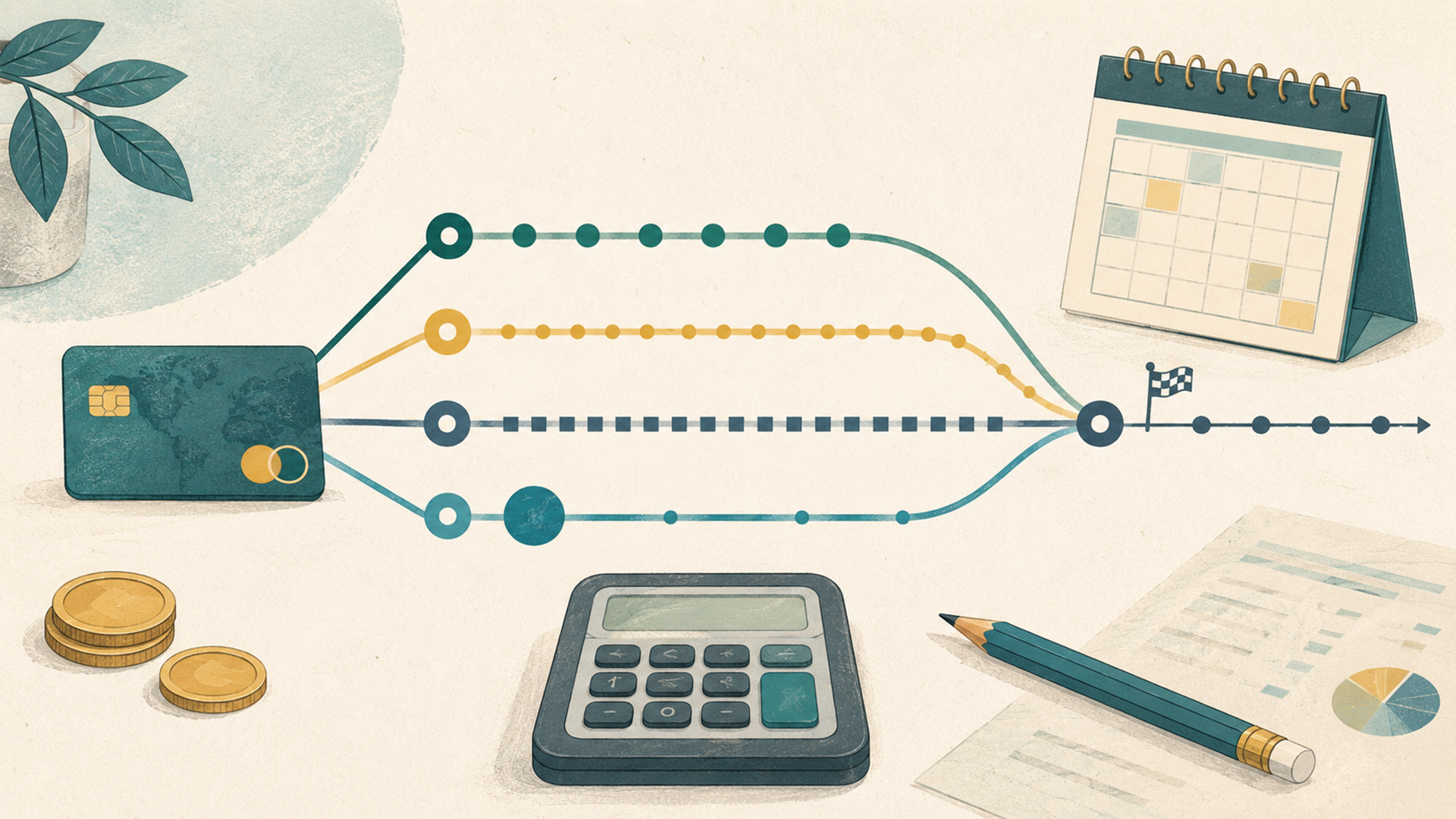
Quick answer: a credit card payoff calculator turns payment choices into timelines
A credit card payoff calculator estimates how long it may take to pay off a credit card balance and how much interest may be paid along the way. The result depends on the balance, APR, payment amount, payment frequency, and whether the plan uses fixed payments, minimum payments, extra payments, or a lump sum.
CreditClear is built for that kind of scenario testing. It is not a lender, debt settlement company, or financial adviser. It is a calculator that makes the tradeoff visible: paying less preserves short-term cash flow, while paying more usually shortens the timeline and reduces interest if the assumptions hold.
Educational note: The examples below are fictional and use simplified assumptions: a $3,000 balance, 24.99% APR, no new purchases, no fees, a constant APR, and monthly payments credited at the end of each month. Real card statements, daily interest methods, promotional terms, fees, issuer minimum formulas, and payment timing can change the outcome. Read Jivaro’s Financial Disclaimer before relying on any finance tool or article.
What a credit card payoff calculator can and cannot show
A payoff calculator is useful because credit card debt is not just one number. A balance changes as interest accrues, payments reduce principal, and new charges or fees move the target. A clean calculator run removes the noise so the reader can compare one choice at a time.
In CreditClear, the key inputs are the card balance, APR, start date, payment strategy, payment frequency, fixed payment amount, extra payment amount, one-time payment timing, and annual payment increases. The useful outputs are the estimated payoff date, interest cost, savings, warning signs, and payoff milestones.
The practical reality behind the math
Credit card issuers earn interest when a balance is carried. Minimum payments keep an account moving, but they are not designed to show the fastest path to a zero balance. The CFPB explains that paying more each month generally reduces the interest paid over time, while paying only the minimum can take years to clear a balance if no additional charges are made.
A calculator cannot promise that a payoff plan will happen. It cannot know future income changes, surprise expenses, cardholder agreement changes, hardship programs, late fees, balance-transfer terms, or new purchases unless those assumptions are entered. Treat the output as a planning estimate, not a guaranteed result.
Credit card payoff calculator scenarios: fixed, minimum, extra, and lump sum
The most useful way to use a payoff calculator is to compare payment strategies side by side. The same balance can produce very different timelines depending on whether the payment is fixed, tied to the minimum, boosted each month, or reduced by a one-time payment.
| Scenario | How it works | Fictional CreditClear test | Tradeoff to understand |
|---|---|---|---|
| Fixed payment | The same payment is made every month until the final smaller payment. | $3,000 balance, 24.99% APR, $120 monthly fixed payment: about 36 months and about $1,281 in interest. Run it in CreditClear. | Easy to understand and plan around, but it requires enough monthly budget room to keep the payment steady. |
| Minimum payment | The payment follows the card issuer’s minimum formula. It may decline as the balance falls. | Assuming a 3% minimum or $25 floor: about 188 months and about $5,206 in interest. Test the baseline. | Lower short-term cash requirement, but often a much longer payoff timeline and higher interest cost. |
| Extra monthly payment | The regular payment is increased, or an extra amount is added above the minimum. | $150 fixed monthly payment instead of $120: about 27 months and about $921 in interest. Compare the extra payment. | Small recurring increases can matter, but the plan only works if the extra amount is actually paid consistently. |
| Lump-sum payment | A one-time payment reduces the balance in addition to the normal payment schedule. | $500 paid at the start plus $120 fixed monthly payments: about 28 months and about $813 in interest. Model the lump sum. | Earlier lump sums usually reduce interest more than later lump sums, but cash reserves and timing still matter. |
The table is not a recommendation. It is a way to see why payoff calculators are useful. A minimum-payment result answers, “What happens if the payment stays low?” A fixed-payment result answers, “What happens if the payment stays steady?” An extra-payment result answers, “What changes if the monthly payment rises?” A lump-sum result answers, “What happens if the balance drops today?”
Examples to test in CreditClear
Example 1: “How long to pay off credit card debt if the payment stays fixed?”
Enter the balance, APR, and a fixed payment amount. In the fictional $3,000 example, a $120 monthly payment takes about three years under the simplified assumptions. This is the cleanest baseline because the payment does not shrink as the balance falls.
What to compare: Run $100, $120, $150, and $200 payments. The difference can show whether the main bottleneck is the APR, the balance, or the payment amount.
Example 2: “What if only the minimum payment is made?”
Minimum payments are useful for seeing the slow baseline, not for assuming the most efficient payoff route. U.S. credit card statements include repayment disclosures for minimum-payment scenarios, and the CFPB’s Regulation Z materials explain that card issuers use the minimum payment formulas that apply to the account when preparing those estimates.
What to compare: Run the minimum-only scenario first, then compare it with a fixed payment. The gap between the two results is often the clearest reason to use a calculator.
Example 3: “What does an extra payment do?”
An extra payment works by reducing the balance faster, which gives interest less principal to build on in later months. In the fictional example, moving from $120 to $150 per month shortens the modeled payoff from about 36 months to about 27 months.
What to compare: Test an extra $25, $50, or $100 per month. Then check whether the added payment is realistic by reviewing actual cash flow in BudgetBee.
Example 4: “Does a lump sum help more now or later?”
A lump sum generally has a bigger interest effect when it happens earlier because the lower balance has more months to reduce interest. In the fictional example, a $500 payment at the start plus $120 monthly payments produces about $813 in modeled interest. The same $500 payment after six months produces about $917 in modeled interest.
What to compare: Run the same one-time payment at the start, after three months, after six months, and after twelve months. The result shows the cost of waiting without turning the example into a personal rule.
Common mistakes when using a payoff calculator
1. Forgetting new purchases
A payoff calculator is usually cleanest when it assumes no new charges. If the card keeps being used, the real payoff date can move even when every scheduled payment is made. The CFPB’s explanation of the three-year payment box makes the same point: the estimate depends on the balance shown and assumes no additional charges.
2. Treating APR as permanent
APR can change because of variable-rate terms, promotional periods ending, penalty pricing, or product terms. A calculator run using one APR is still useful, but the result should be refreshed when the statement APR changes.
3. Comparing weekly, biweekly, and monthly payments without annualizing them
A weekly or biweekly payment can look smaller than a monthly payment, but the annual dollars may be higher or lower depending on the amount entered. Compare total yearly payments, not just the payment label.
4. Assuming “minimum plus extra” is always the same as a fixed payment
If the minimum payment shrinks as the balance falls, then “minimum plus $60” may also shrink over time. That can reduce interest early but still leave a small balance hanging around. A fixed payment keeps pressure on the balance until payoff.
5. Ignoring fees, hardship, or collections situations
A calculator is not a debt-relief plan. If an account is already behind, in collections, subject to legal notices, or causing severe financial stress, the FTC notes that consumers can contact their credit card company directly and do not need to pay a company just to ask about options. A nonprofit credit counselor or qualified professional may be more appropriate for complex situations.
Connect the payoff plan to a budget before trusting the result
The calculator can show what a payment would do. A budget shows whether the payment can survive real life.
A practical workflow looks like this:
- Use CreditClear to run the minimum-payment baseline.
- Run a fixed payment that feels realistic based on current income and bills.
- Use BudgetBee to check whether that payment fits actual spending patterns.
- Look for recurring leaks, not one-time guilt. Jivaro’s guide to bad money habits shows how repeated spending can add up when redirected.
- Return to CreditClear and test the extra payment or lump-sum scenario that the budget can actually support.
For more Jivaro calculators and planning utilities, browse the finance tools hub.
When CreditClear fits — and when a calculator is not enough
CreditClear fits when the question is scenario-based
It is useful for questions like “How long would this balance take at this payment?” “What happens if the payment rises?” “How much could a lump sum change the timeline?” and “How different is minimum-only from fixed-payment payoff?”
A calculator is not enough for complicated debt stress
It may be too simple for accounts with missed payments, legal notices, settlements, hardship plans, deferred-interest promotions, multiple cards with changing terms, or a budget that cannot cover required minimums.
The cleanest takeaway is this: a payoff calculator is strongest when it helps readers understand tradeoffs before making a decision. It is weakest when the real problem is not math, but unstable income, unaffordable minimums, fees, legal pressure, or new charges that keep replacing the balance being paid down.
FAQ
What is a credit card payoff calculator?
It is a planning tool that estimates payoff time and interest cost based on balance, APR, payment amount, payment frequency, and payoff strategy.
Why can minimum payments take so long?
Minimum payments are usually small relative to the balance and may decline as the balance falls, which can leave more principal exposed to interest for longer.
Is a lump sum always better than monthly extra payments?
Not always. A lump sum can reduce interest faster, especially early, but monthly extra payments may be easier to sustain. The better comparison depends on timing and cash flow.
Does CreditClear replace a credit counselor?
No. CreditClear estimates payoff scenarios. It does not negotiate with creditors, review legal notices, provide debt counseling, or give personalized financial advice.
What happens if the APR changes?
The estimate should be rerun with the new APR. A higher APR can lengthen payoff time and increase interest, while a lower APR can reduce the modeled cost.
Can a calculator show the effect of new purchases?
Only if the tool includes those charges or the user adjusts the balance. A payoff plan that assumes no new purchases will not match reality if the card keeps being used.
Sources and notes
This guide is educational and uses simplified examples to explain payoff mechanics. It does not provide individualized debt, credit, tax, legal, or financial advice.
- CreditClear — Jivaro credit card payment calculator used for the article’s internal tool framing.
- BudgetBee — Jivaro budgeting app linked for cash-flow planning around payoff scenarios.
- Consumer Financial Protection Bureau — Explanation of credit card statement repayment estimates and the effect of paying more than the minimum.
- CFPB Regulation Z Appendix M1 — Repayment disclosure assumptions, including issuer minimum payment formulas.
- Federal Trade Commission — General consumer information on contacting creditors and getting out of debt.
- Jivaro Financial Disclaimer — Limits of Jivaro finance, credit, debt, investing, and calculator content.