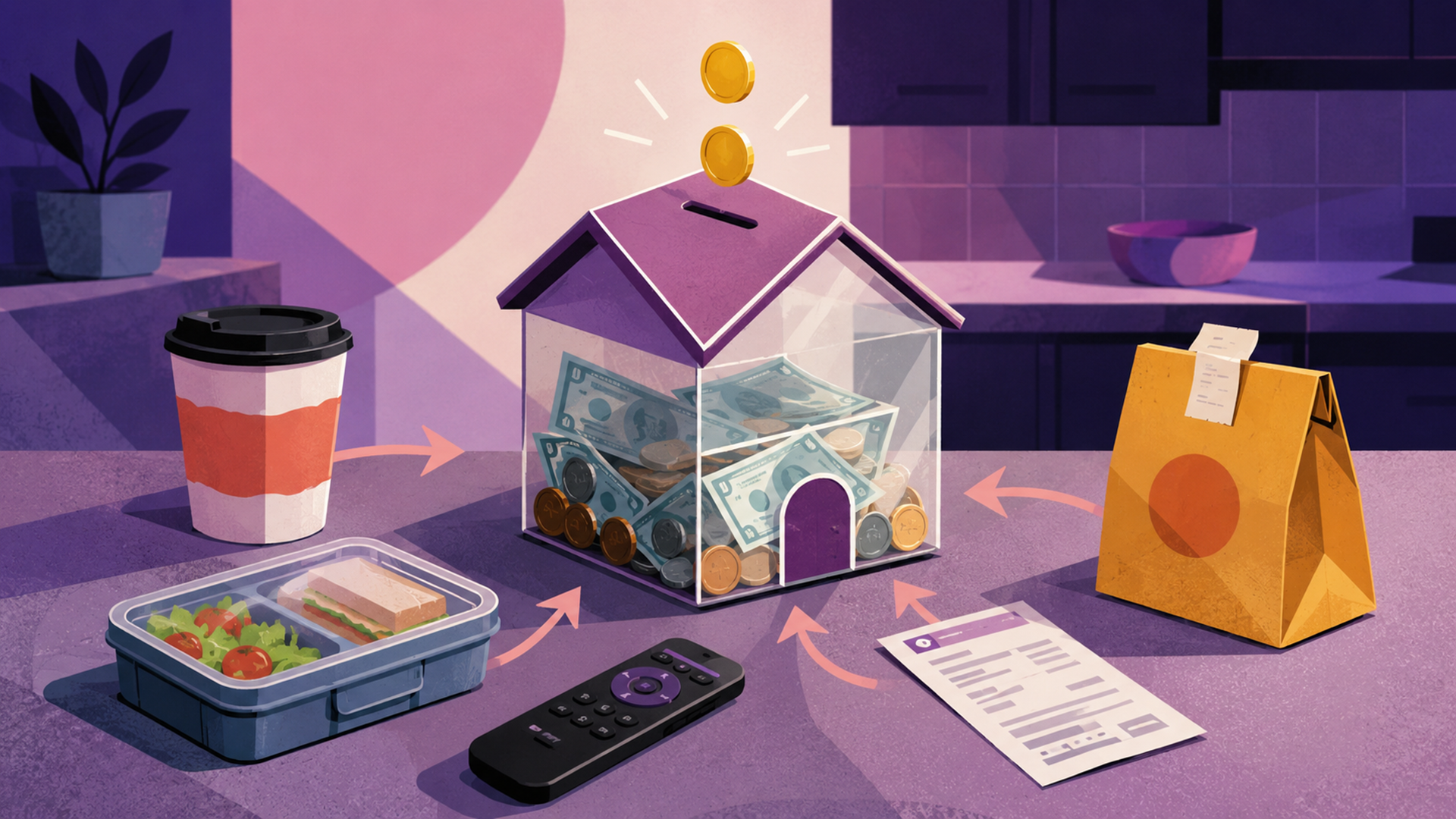
A house down payment usually does not come from one dramatic sacrifice. It often comes from cleaning up the everyday leaks: weekday coffee runs, bought lunches, extra streaming subscriptions, delivery fees, impulse shopping, unused apps, and convenience spending that does not feel expensive until it is added up.
Here is the real math. In this example, cutting nine common spending habits frees up about $798 per month. If that money is saved monthly for five years in an account modeled at a 4% annual rate, it grows to about $52,900 before taxes and account limits. That is enough to clear a rough 10% down payment target on the average-priced new U.S. house in this model.
For context, the average sales price of new houses sold in the U.S. was $514,600 in Q1 2026, while the median sales price was $403,200, based on Census/HUD data published through FRED.
This article is educational only. It is not personalized financial advice. The spending numbers are realistic examples, not universal prices.
The quick answer: small habits can become house money
The math works only when the money is actually redirected. Cutting spending and then letting the cash disappear into other purchases does not build a down payment.
The example below assumes:
- money is saved monthly
- the savings account earns a modeled 4% annual rate
- interest compounds monthly
- no withdrawals are made for five years
- taxes, bank rules, and rate changes are not included
| Monthly savings redirected | Five-year value at 4% annual rate | What it could represent |
|---|---|---|
| $388 | About $25,700 | Roughly 5% down on a $514,600 home. |
| $776 | About $51,500 | Roughly 10% down on a $514,600 home. |
| $1,552 | About $102,900 | Roughly 20% down on a $514,600 home. |
| $798 | About $52,900 | The habit-cutting example in this article. |
The goal is not to shame anyone for buying coffee or watching Netflix. The point is that repeated spending choices have mortgage-sized consequences when they are multiplied across five years.
How much down payment is needed?
A 20% down payment is not always required. Some loan programs allow lower down payments, while some buyers choose a larger down payment to reduce monthly costs, private mortgage insurance, or overall risk. Rules vary by loan type, buyer profile, location, lender, and market conditions.
This article uses three simple targets so the math is easy to see:
| Home price benchmark | 5% down | 10% down | 20% down |
|---|---|---|---|
| $403,200 median new-house sales price | $20,160 | $40,320 | $80,640 |
| $514,600 average new-house sales price | $25,730 | $51,460 | $102,920 |
The rest of the article uses the $514,600 average new-house price as the harder target. That makes the example more demanding: the habit changes need to reach about $51,460 for a 10% down payment.
The bad-habit swaps that can build a down payment
These are not extreme cuts. They are lifestyle edits. The assumptions are intentionally plain:
- Coffee shop drink: $6.25
- Coffee from home: $0.80
- Bought lunch: $14
- Meal-prepped lunch: $5
- Extra streaming services: $15 each
- Savings modeled at 4% annual interest, compounded monthly
| Habit swap | Monthly savings | Annual savings | Five-year value at 4% |
|---|---|---|---|
| Coffee shop 5x/week instead of home coffee | $118 | $1,416 | $7,823 |
| Lunch prep instead of buying lunch 5x/week | $195 | $2,340 | $12,928 |
| Keep 1 streaming subscription instead of 3 | $30 | $360 | $1,989 |
| Replace one weekly delivery order with pickup or cooking | $85 | $1,020 | $5,635 |
| Reduce impulse online shopping | $125 | $1,500 | $8,287 |
| Cancel unused apps, memberships, and trials | $40 | $480 | $2,652 |
| Cut back weekend convenience spending | $100 | $1,200 | $6,630 |
| Plan rides, errands, and parking better | $70 | $840 | $4,641 |
| Keep a phone longer or drop premium device payments | $35 | $420 | $2,320 |
| Total | $798 | $9,576 | $52,907 |
That total is the key. A coffee habit alone does not buy a house. A lunch habit alone probably does not either. But stacked together, these habits can create a real down-payment fund.
Graph: what $798 a month becomes in five years
If the full $798 is saved monthly at a modeled 4% annual rate, the balance builds like this:
Illustrative only. Assumes $798 saved monthly, 4% annual interest, monthly compounding, no withdrawals, and no taxes.
The fifth-year balance clears the rough $51,460 target for a 10% down payment on the average-priced new U.S. house used in this example.
Habit 1: Skip weekday coffee runs
A weekday Starbucks-style habit is one of the easiest examples because the math is simple.
Assumption:
- coffee shop drink: $6.25
- coffee from home: $0.80
- difference: $5.45
- schedule: 5 workdays per week
That creates about $118 per month in savings.
| Coffee choice | Monthly cost | Five-year value if redirected |
|---|---|---|
| Coffee shop 5x/week | About $135 | — |
| Coffee from home 5x/week | About $17 | — |
| Difference saved | About $118 | About $7,823 |
The point is not that nobody should buy coffee. It is that a small daily upgrade can quietly become a five-year down-payment line item.
Habit 2: Meal prep instead of buying lunch every workday
Lunch is usually the biggest easy win. Buying fast food or takeout during the workweek can feel normal because each purchase is small. The monthly total is not small.
Assumption:
- bought lunch: $14
- meal-prepped lunch: $5
- difference: $9
- schedule: 5 workdays per week
That creates about $195 per month in savings.
| Lunch choice | Monthly cost | Five-year value if redirected |
|---|---|---|
| Buying lunch 5x/week | About $303 | — |
| Meal prep 5x/week | About $108 | — |
| Difference saved | About $195 | About $12,928 |
Lunch prep does not need to mean eating the same sad meal every day. The practical version is boring but effective: a few default meals, leftovers used on purpose, and fewer “I forgot food, so I guess I’m buying lunch” days.
Habit 3: Keep one streaming subscription active
Streaming is a perfect example of lifestyle creep because each service seems cheap by itself. The problem is the stack.
Assumption:
- one streaming subscription: $15
- three subscriptions: $45
- savings from keeping one active: $30 per month
| Streaming setup | Monthly cost | Five-year value if redirected |
|---|---|---|
| 3 active subscriptions | $45 | — |
| 1 active subscription | $15 | — |
| Difference saved | $30 | $1,989 |
This does not require giving up entertainment. It means rotating services. Keep one active, finish what is worth watching, cancel it, and switch later.
Habit 4: Cut one delivery order per week
Food delivery is not just the food price. It often adds delivery fees, service fees, tips, and menu markups. Even one avoided delivery order per week can matter.
Assumption:
- one avoided delivery premium per week: about $20
- monthly savings: about $85
| Delivery habit | Monthly savings | Five-year value if redirected |
|---|---|---|
| Replace one weekly delivery order | $85 | $5,635 |
The realistic substitute is not “never order food again.” It is building a default plan: pickup instead of delivery, frozen backup meals, or cooking twice and eating leftovers once.
Habit 5: Reduce impulse online shopping
Impulse shopping is harder to track because it rarely feels like one habit. It looks like small carts, sale items, late-night purchases, “only $29” upgrades, and things bought because returning them is annoying.
Assumption:
- reduced impulse shopping: $125 per month
| Habit change | Monthly savings | Five-year value if redirected |
|---|---|---|
| Fewer small carts and sale buys | $125 | $8,287 |
The strongest rule is a waiting period. Anything nonessential over a set dollar amount waits 48 hours. If it still solves a real problem after two days, it can be reviewed. If it was just boredom, the money stays in the house fund.
Habit 6: Cancel unused apps, memberships, and trials
A lot of budgets leak through subscriptions nobody actively chose this month. App trials renew. Fitness memberships sit unused. Cloud storage, newsletters, premium tools, and “just in case” services keep billing quietly.
Assumption:
- canceled unused subscriptions: $40 per month
| Habit change | Monthly savings | Five-year value if redirected |
|---|---|---|
| Cancel unused recurring charges | $40 | $2,652 |
This is one of the cleanest fixes because it does not require daily discipline. Cancel once, automate the savings transfer, and the money stops leaking.
Habit 7: Cut back weekend convenience spending
Weekend spending often hides in convenience: drinks, snacks, rides, parking, late-night food, premium groceries, and quick stops that were not planned.
Assumption:
- reduced weekend convenience spending: $100 per month
| Habit change | Monthly savings | Five-year value if redirected |
|---|---|---|
| Fewer unplanned weekend convenience buys | $100 | $6,630 |
This is not about becoming antisocial. It is about choosing the thing that actually matters and cutting the filler around it.
Habit 8: Plan rides, errands, and parking better
Rideshares, last-minute parking, extra delivery fees, and poorly planned errands are not always avoidable. But many households can reduce them with better planning.
Assumption:
- reduced transportation convenience spending: $70 per month
| Habit change | Monthly savings | Five-year value if redirected |
|---|---|---|
| Better ride, errand, and parking planning | $70 | $4,641 |
This can include batching errands, comparing pickup versus delivery, using public transit selectively, or planning nights out before the most expensive option becomes the default.
Habit 9: Stop phone-upgrade creep
Phone payments are easy to normalize because they get bundled into a monthly bill. A premium device, insurance add-on, accessory financing, or early upgrade cycle can quietly eat into a down-payment plan.
Assumption:
- reduced phone/device payment creep: $35 per month
| Habit change | Monthly savings | Five-year value if redirected |
|---|---|---|
| Keep a phone longer or reduce device-payment creep | $35 | $2,320 |
A working phone does not need to become a permanent car-payment-style line item. Keeping a device longer can be one of the least painful savings moves.
What this plan can and cannot do
This plan can show how everyday spending can become a down-payment fund. It can also help make the tradeoff visible: every recurring habit is competing with a future housing goal.
It cannot solve every housing problem.
A down payment is not the full cost of buying a house. Buyers may also need money for closing costs, moving costs, inspections, repairs, emergency savings, insurance, taxes, and lender reserves. Mortgage approval also depends on income, credit, debt-to-income ratio, location, loan type, and interest rates.
The clean takeaway is this: cutting habits can build the down payment, but buying a house still requires a broader financial plan.
A simple 30-day reset
A practical reset does not need to be dramatic. It needs to be specific.
- Pick the target. Choose a 5%, 10%, or 20% down-payment goal based on the price range being considered.
- Open or identify the house fund. Keep it separate from daily spending money.
- Choose the first three habit cuts. Coffee, lunch, and subscriptions are usually the cleanest starting points.
- Automate the transfer. Move the savings right after payday, not at the end of the month.
- Track the actual balance monthly. The number matters more than the intention.
- Review every 90 days. Spending habits change. The plan should be adjusted before drift becomes normal.
FAQ
Can cutting coffee really help buy a house?
Coffee alone probably will not create a full down payment. In this model, replacing weekday coffee-shop drinks with home coffee saves about $118 per month, which grows to roughly $7,823 over five years at a modeled 4% annual rate. The bigger result comes from stacking several habit changes.
Is a 4% savings rate guaranteed?
No. Savings-account rates change, and taxes may apply to interest. The 4% rate here is a modeling assumption, not a guarantee.
Does someone need 20% down to buy a house?
Not always. Some buyers use lower-down-payment loans, while others aim for 20% to reduce monthly costs or avoid certain added expenses. Loan requirements vary by program, lender, borrower profile, and location.
What habit saves the most money in this example?
Meal prep creates the largest single savings amount in this model: about $195 per month, or about $12,928 after five years at a modeled 4% annual rate.
What if local home prices are much higher?
The monthly savings target should be adjusted. The same habits may cover a 5% down payment in a high-cost area but a 10% or larger target in a lower-cost area. The framework still works, but the target price matters.
Should this money be invested instead of saved?
For a five-year house goal, many buyers prefer lower-volatility savings options because the money may be needed on a specific timeline. Investing can offer higher potential returns, but it can also lose value at the wrong time. The right choice depends on timeline, risk tolerance, and how flexible the homebuying plan is.
Conclusion
Bad money habits do not always look bad in the moment. A coffee run feels small. A lunch order feels normal. A streaming subscription feels harmless. A delivery order feels convenient. But repeated spending becomes powerful when it is redirected with a purpose.
In this example, cutting nine common habits saves about $798 per month. Saved monthly at a modeled 4% annual rate, that becomes about $52,900 in five years—enough to clear a rough 10% down-payment target on the average-priced new U.S. house used in the model.
The lesson is not that every pleasure should disappear. It is that the house fund has to win more often than the habits do.