
How to work in Japan depends on two things: the work you want to do and the status of residence that legally allows you to do it. A job offer matters, but the job has to match a visa category, your background has to match the requirements, and the employer usually has to support the immigration process.
The mistake is thinking there is one “Japan work visa.” Japan has many work-related statuses of residence: Engineer/Specialist in Humanities/International Services, Instructor, Professor, Intra-company Transferee, Business Manager, Highly Skilled Professional, Specified Skilled Worker, Nursing Care, Skilled Labor, and more. Japan also has program routes like JET, Working Holiday, J-Find, J-Skip, and Digital Nomad, each with different rules.
This guide separates the path for people outside Japan from the path for people already in Japan, then shows where to find jobs, which visa routes fit which workers, and how to avoid wasting time on jobs that cannot sponsor you.
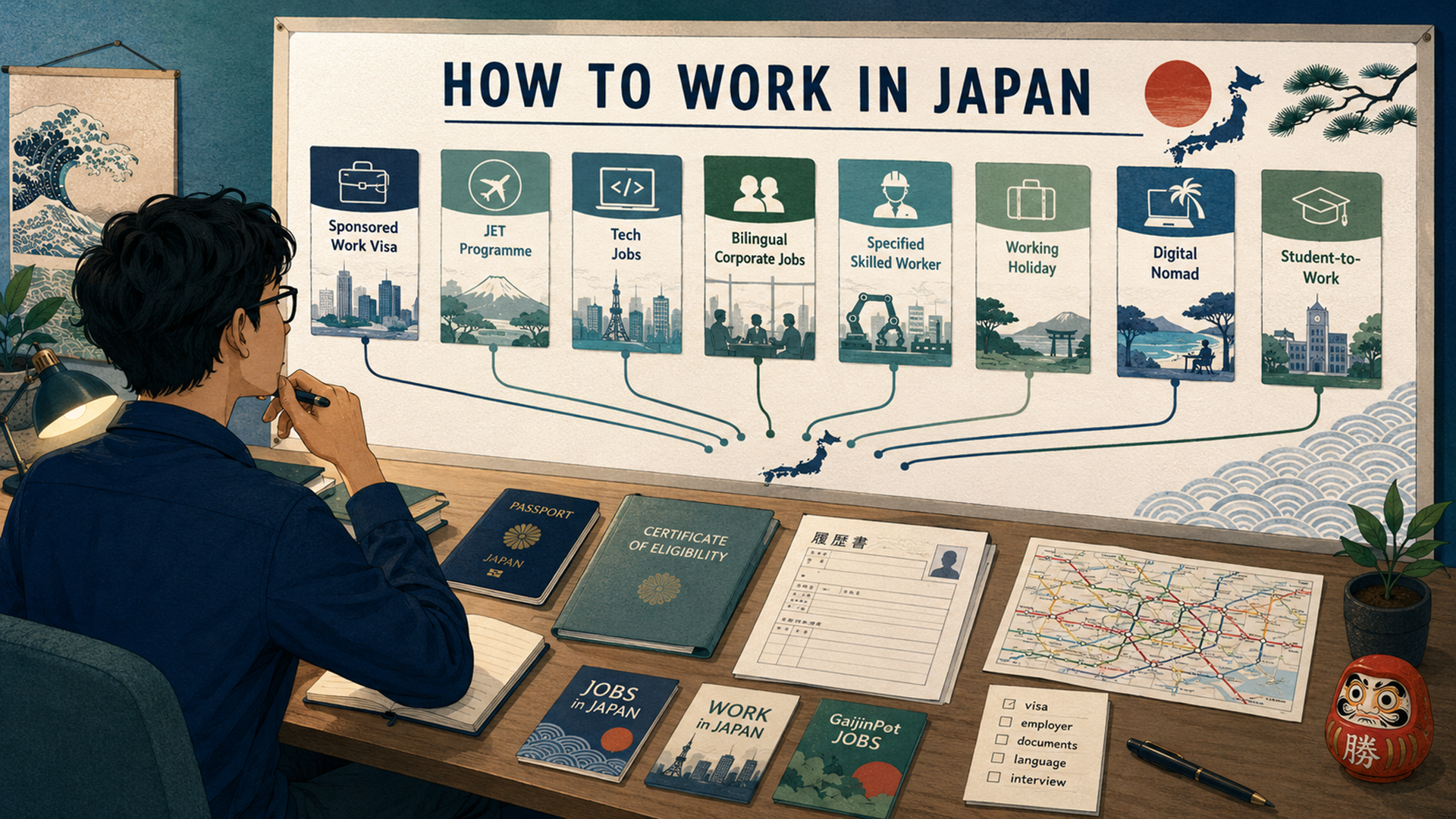
Quick answer: how do you work in Japan legally?
Most people work in Japan through one of six routes:
- Get hired by a Japanese employer that sponsors a work-eligible status of residence. This is the normal route for engineers, designers, marketers, translators, bilingual corporate workers, instructors, professors, chefs, and many professionals.
- Apply through a formal program such as the JET Programme. This is one of the most structured routes for teaching and international exchange work.
- Use a Working Holiday visa if your nationality and age qualify. This is a travel-first route that allows incidental work to fund your stay.
- Use the Specified Skilled Worker route for labor-shortage industries. This route usually requires skills and Japanese-language testing or a qualifying training background.
- Study in Japan first, then switch to work after graduation. This can work if your school, degree, employer, job duties, and status-change application line up.
- Use a special route such as J-Find, J-Skip, Business Manager, Intra-company Transferee, or Digital Nomad. These fit narrower cases and are not general job-hunting shortcuts.
Important: do not assume you can work on a tourist stay. Japan’s work and long-term-stay visa categories are specific, and the activity must match the status of residence. Always verify your route with official Japanese immigration or embassy sources before making plans.
The two main paths: outside Japan vs. already in Japan
The strategy changes depending on where you are now. If you are outside Japan, your goal is usually to get an employer, school, program, or qualifying route that can support entry. If you are already in Japan, your goal is often to change or renew your status of residence without violating your current status.
| Situation | Your main problem | Best routes to check first | What not to do |
|---|---|---|---|
| Outside Japan | You need a realistic path to enter Japan with the right status. | Sponsored work visa, JET Programme, Working Holiday, Specified Skilled Worker, intra-company transfer, student route, J-Find, J-Skip, Digital Nomad. | Apply only to jobs that say “must already live in Japan” unless you have a plan to meet that condition. |
| Already in Japan as a student | You may need permission for part-time work now and a status change after graduation. | Part-time permission, school career office, Hello Work foreigner centers, company career pages, new-graduate hiring, status change to work. | Work outside your permission or assume any job can sponsor any visa. |
| Already in Japan on Working Holiday | You can work incidentally, but the program is not the same as a long-term work visa. | Hospitality, service, language-related jobs, internships, recruiters, direct employer search, later work sponsorship if eligible. | Assume Working Holiday itself is a permanent work route. |
| Already in Japan on a work status | Your next job must still match your status or require a change/permission. | CareerCross, Daijob, LinkedIn, recruiters, Hello Work, company career pages. | Start a different type of job before confirming status requirements. |
| Remote worker wanting Japan | You need to distinguish remote work from employment in Japan. | Digital Nomad if eligible, long-stay sightseeing if wealthy enough, employer-approved business travel, or a real Japanese work route. | Assume tourist status allows normal remote work from Japan. |
How Japan’s work visa system actually works
Japan uses “statuses of residence,” not one general work visa. A status of residence defines what activities you can do in Japan. MOFA’s official work and long-term-stay visa page lists many categories, including Highly Skilled Professional, Professor, Business Manager, Engineer/Specialist in Humanities/International Services, Intra-company Transferee, Nursing Care, Skilled Labor, Specified Skilled Worker, Technical Intern Training, Student, Working Holiday-related Designated Activities, Future Creation Individual, and Digital Nomad.
For many work routes, the employer in Japan applies for or supports a Certificate of Eligibility, often called a COE. The COE can make the visa application and landing examination smoother, but MOFA notes that a COE does not guarantee visa issuance.
Think of the system as a match between four things:
- Your background: degree, work experience, license, language, nationality, age, income, or school history.
- The job duties: what you will actually do day to day.
- The employer or program: company, school, local government, registered support organization, or overseas employer for digital nomads.
- The status of residence: the legal category that permits that activity.
If any of those four do not line up, the application can fail or the job may not be legal for you.
Japan work visa and program route table
This table is a practical guide, not legal advice. Use it to understand which routes are worth researching, then verify the exact requirements with the Immigration Services Agency, MOFA, a Japanese embassy or consulate, your school, employer, or a qualified immigration professional.
| Route | Best for | Typical work | What usually matters | First place to check |
|---|---|---|---|---|
| Engineer/Specialist in Humanities/International Services | Many professionals and foreign graduates. | IT engineering, design, marketing, translation, interpretation, planning, language services, business roles. | Degree or relevant background, job duties, employer sponsorship, salary, contract, and role fit. | MOFA work/long-term-stay visa page and employer immigration support. |
| Instructor | School teaching roles. | Teaching at elementary, junior high, high schools, and similar institutions. | School type, teaching duties, employer, qualifications, and contract. | MOFA working visa categories and employer. |
| Professor | University and academic roles. | University professor, assistant professor, research/academic teaching. | Academic institution, appointment, research/teaching role, credentials. | University hiring page and MOFA. |
| Intra-company Transferee | People transferred by a multinational company. | Work at a Japanese branch, subsidiary, or related office. | Internal transfer relationship, prior employment, contract, job duties, company documentation. | Your employer’s global mobility team. |
| Highly Skilled Professional | High-scoring professionals, researchers, engineers, executives. | Advanced academic, technical, or business work. | Points, income, education, research, experience, and official criteria. | Immigration Services Agency and MOFA. |
| J-Skip | Special highly skilled professionals. | High-level professional or executive work. | Educational background, work history, salary, and special highly skilled criteria. | Immigration Services Agency J-Skip/J-Find materials. |
| J-Find / Future Creation Individual | Recent graduates of eligible top universities who want time to job-hunt or start a business in Japan. | Job hunting, preparation to start a business, related activities under the designated route. | Eligible university, graduation timing, funds, documents, and activity plan. | MOFA Future Creation Individual / ISA J-Find materials. |
| Specified Skilled Worker | Workers in specified labor-shortage industries. | Nursing care, building cleaning, construction, manufacturing, accommodation, agriculture, food manufacturing, and other covered fields. | Industry skills test, Japanese test, contract, employer support, field restrictions. | Specified Skilled Worker official support site. |
| Nursing Care | Certified care workers. | Care work in Japan. | Certification, employer, job duties, Japanese ability, and care-sector requirements. | Employer and immigration guidance. |
| Skilled Labor | Specialized skilled workers. | Foreign cuisine chefs, pilots, sports trainers, sommeliers, animal trainers, and other specialized roles. | Years of experience, specialized duties, employer, and documentation. | MOFA working visa categories and employer. |
| Business Manager | Entrepreneurs and managers running or managing a business in Japan. | Business management and operations in Japan. | Business plan, office, capital/staffing requirements, management experience, and updated official criteria. | Immigration Services Agency Business Manager page. |
| Student to work | People studying in Japan who want to work after graduation. | New graduate corporate roles, technical roles, teaching, translation, office work. | School, degree, job duties, timing, permission for part-time work, status change application. | School career office, Hello Work, employer, ISA student-to-work materials. |
| Working Holiday | Young people from partner countries who want to live in Japan temporarily. | Travel-first stay with incidental work to supplement funds. | Nationality, age, funds, health, application at embassy/consulate, prohibited workplaces. | MOFA Working Holiday page and your local Japanese embassy. |
| JET Programme | Teaching and international exchange route from abroad. | ALT, CIR, SEA roles with local governments and schools. | Nationality, degree, application cycle, placement, language, and program eligibility. | JET Programme official site and your country’s JET application page. |
| Digital Nomad | High-income remote workers staying temporarily. | Remote work for an overseas employer/client while in Japan. | Eligible country, six-month stay, annual income of JPY 10 million or more, insurance, documents. | MOFA Digital Nomad page and ISA eligibility list. |
If you are outside Japan: the cleanest plan
If you are applying from abroad, your main goal is to find employers, programs, or routes that accept overseas candidates. Many Japan job listings say “must already reside in Japan” or “must already have a valid status of residence.” Skip those unless you already meet the condition.
Use this sequence:
- Choose a realistic route. Teaching, tech, bilingual corporate, Working Holiday, SSW, student route, intra-company transfer, JET, Digital Nomad, or J-Find/J-Skip.
- Check whether your nationality, degree, language level, income, age, and experience fit. Do this before applying.
- Search only platforms that show visa support or overseas hiring. Use keywords like “visa sponsorship,” “overseas applicants,” “Japan relocation,” and “English OK.”
- Apply to employers or programs that understand the COE/visa process. A company that has never hired a foreign worker may still be possible, but it is harder.
- After an offer, confirm the immigration route in writing. Ask which status of residence the employer expects to use.
- Wait for the official process. Do not enter Japan on a short tourist stay and start working unless your status explicitly allows the work.
Application phrase to look for: “visa sponsorship available,” “overseas candidates welcome,” “relocation support,” “Engineer/Specialist in Humanities/International Services,” “work visa support,” or “COE support.”
If you are already in Japan
If you are already in Japan, the question is not only “Can I get hired?” It is “Can I legally do this work under my current status, or do I need permission or a status change?”
Students, dependents, and some designated-activities holders may need permission for activities outside their status. Japan’s Immigration Services Agency explains that permission is needed when a person wants to engage in income-generating activities outside the activity covered by their current status; its page also describes comprehensive permission for part-time-style work up to 28 hours per week for eligible statuses such as Student and Dependent.
| Your current situation | What to do first | Where to look | Big warning |
|---|---|---|---|
| Student in Japan | Check part-time permission and school rules; plan a status change before graduation. | School career center, Hello Work foreigner service centers, CareerCross, Daijob, company career pages. | Part-time permission is not the same as full-time work permission. |
| Working Holiday holder | Use the visa for temporary work while exploring longer-term sponsorship. | GaijinPot Jobs, hospitality listings, recruiters, LinkedIn, direct employer search. | Working Holiday is travel-first and temporary; some workplaces are prohibited. |
| Existing work status | Confirm whether the new role fits your current status or needs a change. | CareerCross, Daijob, LinkedIn, recruiters, current network. | Changing fields can require new approval before starting. |
| Spouse, long-term resident, permanent resident | Check whether your status has work restrictions. | General job boards, recruiters, Hello Work, company pages. | Do not assume every family/resident status has the same conditions. |
| Tourist or short-term visitor | Do not work unless the activity is clearly permitted. | Use the time for research, networking, interviews if allowed, and returning for the correct status. | Tourist status is not a general work route. |
Where to find jobs in Japan
For most foreign job seekers, the best job boards depend on language level and industry. English-first boards are useful, but the biggest Japanese market is still Japanese-language hiring. If you can search in Japanese, you dramatically expand your options.
| Site or channel | Best for | Use it when | Search tip |
|---|---|---|---|
| Daijob | Bilingual professionals and global companies. | You have business English, Japanese, or international-company experience. | Search by language level, industry, salary, and visa sponsorship terms. |
| CareerCross | Bilingual corporate roles, recruiters, specialist jobs. | You want filters for Japanese level, English usage, salary, work style, location, and visa status. | Use Japanese level and visa-status filters before browsing titles. |
| GaijinPot Jobs | Foreigner-facing jobs, teaching, hospitality, service, bilingual roles. | You want English-language listings and jobs aimed at foreign residents or applicants. | Check whether the role sponsors from abroad or requires current residence. |
| TokyoDev | IT jobs for English-speaking developers in Japan. | You are a software engineer or technical professional. | Check remote, relocation, visa sponsorship, Japanese requirements, and salary. |
| Japan Dev | Developer jobs with Japan-based companies. | You want tech roles that are more foreigner-friendly than typical Japanese job boards. | Filter by role, salary, visa sponsorship, Japanese level, and remote options. |
| Wantedly | Startups, mission-driven companies, casual first-contact recruiting. | You can read Japanese or want startup discovery. | Use it for company research and networking, not only direct applications. |
| International companies, recruiters, tech, sales, marketing, finance. | You want to be discoverable to recruiters and compare global companies in Japan. | Search “Japan visa sponsorship,” “Tokyo bilingual,” and exact role titles. | |
| Hello Work | People already in Japan, local roles, public employment support. | You need local job support or are changing jobs inside Japan. | Also check foreigner employment service centers in Tokyo, Nagoya, Osaka, and Fukuoka. |
| Recruiting agencies | Mid-career bilingual roles, finance, legal, tech, sales, healthcare, executive roles. | You have experience and want recruiter access to companies hiring foreigners. | Try Robert Walters, Hays, Michael Page, JAC Recruitment, Randstad, and specialist firms. |
| Company career pages | Direct applications and accurate visa/location requirements. | You know target employers or industries. | Build a list of 30 companies and check them weekly. |
JET Programme and English teaching routes
The JET Programme is one of the most structured ways to work in Japan, especially for people applying from abroad. It is not only “English teaching.” JET has three main positions: Assistant Language Teacher, Coordinator for International Relations, and Sports Exchange Advisor. The official JET site says ALTs assist language instruction in schools, CIRs support translation, interpretation, and international exchange activities, and SEAs promote exchange through sports instruction.
JET is a strong fit if you want a government-backed program route, are comfortable being placed outside major cities, and want structured entry into Japan. It is less ideal if you need control over city, school, salary negotiation, or long-term career track.
| Teaching route | Best for | Common status | Reality check |
|---|---|---|---|
| JET Programme ALT | Graduates who want a structured public-school route. | Usually Instructor or related program-supported status. | Placement is not fully under your control; rural placements are common. |
| Private ALT dispatch companies | People who want teaching roles outside JET timing. | Usually Instructor or Engineer/Specialist depending on role. | Pay and conditions vary widely by company and contract. |
| Eikaiwa conversation schools | People comfortable with private language school schedules. | Often Engineer/Specialist in Humanities/International Services. | Evenings and weekends may be normal. |
| International schools | Licensed teachers with classroom experience. | Varies by school and role. | Often requires teaching credentials and experience, not only native English. |
| University teaching | People with graduate degrees, publications, and teaching experience. | Professor. | Competitive and often requires Japanese academia familiarity. |
JET eligibility includes requirements such as interest in Japan, health, adaptability, a bachelor’s degree or qualifying teaching credential for ALT applicants, nationality of the country where recruitment takes place, and strong ability in the designated language. Check your country’s JET application page because timelines and procedures differ.
Tech jobs and startup work in Japan
Tech is one of the most realistic non-teaching routes for foreigners who want professional work in Japan. Software engineering, data engineering, machine learning, infrastructure, security, product design, product management, and developer relations can be easier to match to a work status than vague “business support” jobs.
Start with TokyoDev, Japan Dev, LinkedIn, Wantedly, CareerCross, and direct company pages.
Search like this:
site:company-careers-page software engineer Japan visa sponsorship
Tokyo backend engineer English OK
Japan Dev remote visa sponsorship
TokyoDev React TypeScript no Japanese required
LinkedIn Japan machine learning engineer visa support
Wantedly エンジニア 英語 東京
For tech roles, your proof matters: GitHub, shipped products, portfolio, architecture notes, open-source work, production systems, case studies, or technical writing. If you need sponsorship from abroad, make the employer’s risk feel smaller by proving you can do the job without hand-holding.
Bilingual corporate jobs and recruiters
Bilingual corporate roles are a major route for people with Japanese and English ability. This includes sales, marketing, finance, HR, operations, legal, compliance, supply chain, customer success, project management, translation, localization, and consulting.
Start with Daijob, CareerCross, LinkedIn, recruiters, and company pages. CareerCross is especially useful because its filters include Japanese level, English level, job type, work style, visa-status-related fields, salary, career level, and industry.
| Corporate route | Good fit | Japanese level | Where to look |
|---|---|---|---|
| Foreign-owned company in Japan | People with global-company experience and English business fluency. | Often business Japanese helps; some roles English-first. | LinkedIn, CareerCross, Daijob, recruiters. |
| Japanese company global role | People who can bridge Japan and overseas markets. | Usually N2 to N1 or business Japanese. | Daijob, CareerCross, Wantedly, recruiters, company pages. |
| Recruiter-mediated role | Mid-career professionals with clear skills. | Varies by industry and company. | Robert Walters, Hays, Michael Page, JAC Recruitment, Randstad, specialized recruiters. |
| Localization / translation | People with writing, translation, product, gaming, or content experience. | Often high Japanese plus native-level target language. | CareerCross, Daijob, LinkedIn, game-company career pages. |
Specified Skilled Worker route
The Specified Skilled Worker route is for specific industries facing labor shortages. The official SSW support site explains that Specified Skilled Worker is a status of residence for working, while Technical Intern Training is for acquiring skills. SSW(i) allows work in Japan for a total of five years and generally does not allow family accompaniment; SSW(ii) has no upper limit to length of stay and can allow family accompaniment.
The official SSW site lists 19 fields for SSW(i), including nursing care, building cleaning, construction, industrial product manufacturing, shipbuilding, automobile repair, aviation, accommodation, agriculture, fishery/aquaculture, food manufacturing, food service, forestry, wood industry, resource recycling, linen services, logistics warehouse, and transport/railway-related fields. It also notes that food service is not accepting new applications at the time shown on the page.
For SSW(i), the official steps page explains that you generally need to pass both a skills test and a Japanese-language test, such as JFT-Basic or JLPT N4 or higher, with higher requirements for some fields. After finding a company and signing a contract, the status application process begins.
| SSW step | What happens | What to verify |
|---|---|---|
| Choose field | Pick an SSW-covered industry. | Whether the field is accepting applications and whether your target job fits. |
| Pass tests | Take skills and Japanese tests unless exempt through qualifying routes. | Which test is required for your field and country. |
| Find employer | Use sending organizations where required, company websites, job fairs, and official resources. | Whether fees are legitimate and the employer is real. |
| Sign contract | Get clear written employment conditions. | Salary, location, duties, support, housing, deductions, and work conditions. |
| Apply for status | Employer or representative supports application to immigration. | Documents, timeline, COE/visa process, and whether you can change jobs later. |
Working Holiday route
Japan’s Working Holiday Programme is for young people from partner countries or regions who primarily want to holiday in Japan while working incidentally to supplement travel funds. MOFA says Japan has introduced Working Holiday arrangements with 32 countries/regions as of April 1, 2026, and the basic eligibility includes factors such as nationality, residence, age, funds, passport, health, and not having previously used the visa except where newer country-specific exceptions apply.
This is a flexible route, but it is not a general work visa. MOFA also states that participants are prohibited from working at bars, cabarets, nightclubs, gambling establishments, and other premises affecting public morals.
| Working Holiday is good for | Working Holiday is not good for |
|---|---|
| Testing life in Japan before committing long-term. | Guaranteed permanent work in Japan. |
| Hospitality, seasonal work, language-related work, light office work, travel funding. | Jobs that require a long-term specialized work status from day one. |
| Networking locally and interviewing in person. | Ignoring age, nationality, funds, and embassy requirements. |
| People from eligible partner countries/regions. | People from countries without a Working Holiday arrangement with Japan. |
Japan Digital Nomad visa route
Japan’s Digital Nomad route is not a normal job route and not a way to work for a Japanese employer. MOFA describes it as a Designated Activities status for individuals wishing to work remotely in Japan for a period not exceeding six months. The period of stay is six months and no extension is granted. Required documents include proof of annual income of JPY 10 million or more and insurance covering medical treatment for injury or illness of JPY 10 million or more.
This route is worth checking if you already have high remote income from outside Japan and your nationality is eligible. It is not a route for ordinary local job hunting, part-time work in Japan, or entry-level employment.
| Digital Nomad fits | Digital Nomad does not fit |
|---|---|
| High-income remote workers with overseas clients or employers. | People seeking local Japanese employment. |
| People planning a temporary stay of up to six months. | People who need a renewable long-term residence path. |
| People who meet income, insurance, nationality, and document requirements. | People who want to work for a Japanese company in Japan. |
J-Find, J-Skip, and high-skill routes
Japan has special routes for certain high-potential or highly skilled applicants. MOFA’s work and long-term-stay page lists “Special Highly skilled professional” under Highly Skilled Professional and “Designated activities (Future creation individual)” under specified visas. These are commonly associated with J-Skip and J-Find.
Use these routes only if your background clearly matches them. They are not beginner job-board shortcuts. If you graduated from an eligible top university, have strong funds, and want to job-hunt or start a business in Japan, J-Find may be worth checking. If you have exceptional education, work history, income, or executive/research qualifications, J-Skip may be worth checking.
| Route | Who should check it | Why it matters | What to verify |
|---|---|---|---|
| J-Find / Future Creation Individual | Graduates of eligible high-ranking universities who want to job-hunt or prepare a startup in Japan. | It can give a structured temporary bridge into Japan for qualified graduates. | University eligibility, graduation timing, funds, documents, and allowed activities. |
| J-Skip / Special Highly Skilled Professional | High-income, high-skill researchers, engineers, executives, or specialists. | It can simplify or accelerate some high-skill immigration pathways. | Income, education, work history, occupation, employer, and official criteria. |
| Highly Skilled Professional points route | People who score well under Japan’s highly skilled professional system. | It can offer preferential treatment compared with ordinary work statuses. | Points, supporting documents, employer, salary, and category. |
How much Japanese do you need?
You can work in Japan with low Japanese in some jobs, but Japanese ability expands your options dramatically. The difference between “English OK” and “business Japanese” can be the difference between a few boards and the full Japanese market.
| Japanese level | Realistic job targets | Where to search | Limitations |
|---|---|---|---|
| No Japanese | Some English teaching, some tech roles, some global companies, some hospitality/Working Holiday jobs. | JET, GaijinPot Jobs, TokyoDev, Japan Dev, LinkedIn, WeXpats-style boards, direct foreign-owned companies. | Fewer roles, more competition, more location/visa restrictions. |
| Basic Japanese / N5-N4 | Service, hospitality, support roles, SSW-related prep, some local jobs with training. | GaijinPot, Hello Work, Working Holiday routes, SSW resources. | Not enough for many corporate roles. |
| Conversational / N3 | Some customer-facing roles, operations, hospitality, logistics, startups, support. | CareerCross, Daijob, Wantedly, Hello Work, recruiters. | Business documents and interviews may still be difficult. |
| Business Japanese / N2 | Bilingual corporate roles, sales, marketing, HR, project management, customer success, localization. | Daijob, CareerCross, LinkedIn, recruiters, Japanese company pages. | You still need domain skills, not only language. |
| Advanced / N1 or near-native | Japanese corporate roles, legal-adjacent roles, translation, management, government-adjacent, senior bilingual roles. | Japanese boards, recruiters, company pages, professional networks. | Japanese skill alone is not a career plan; pair it with a field. |
Application materials for Japan
Japan job applications can require different documents depending on the company. International companies may accept a Western-style resume. Japanese companies may expect a rirekisho and shokumukeirekisho. Recruiters may ask for both English and Japanese versions.
| Document | What it is | When you need it | Tip |
|---|---|---|---|
| English resume | Western-style work history focused on results and skills. | Global companies, tech startups, recruiters, English-first roles. | Add visa status, location, relocation timing, Japanese level, and work authorization truthfully. |
| Japanese rirekisho | Standard Japanese resume with education, work history, personal details, and formal structure. | Japanese companies, local applications, Hello Work, some recruiters. | Use the expected format and avoid over-styling it. |
| Shokumukeirekisho | Detailed career-history document. | Mid-career professional roles in Japan. | Show projects, responsibilities, achievements, tools, and industries. |
| Portfolio | Proof of work: GitHub, design, writing, campaigns, translation samples, case studies. | Tech, design, writing, marketing, translation, product, AI evaluation. | Use English and Japanese if the role is bilingual. |
| Degree/certification documents | Proof needed for visa, teaching, care, medical, skilled labor, or professional roles. | Visa process, employer onboarding, regulated industries. | Keep originals, copies, translations, and apostille/legalization needs organized. |
For applications from abroad, be upfront:
Location: Currently in [Country], available to relocate to Japan.
Visa: Will require employer-supported work status / COE process.
Japanese: JLPT N2, business conversation; English native.
Availability: Can interview remotely and relocate after visa approval.
Salary, work culture, and practical reality
Japan can be a good place to work, but expectations vary by industry. Tech startups, foreign companies, eikaiwa schools, universities, factories, hotels, Japanese corporations, and local government programs all operate differently.
Before accepting an offer, ask about:
- base salary and bonus structure
- overtime rules and expected overtime
- commuting allowance
- housing support, if any
- social insurance and pension enrollment
- contract length
- probation period
- visa/status sponsorship
- job duties used for immigration documents
- relocation support
- language expectations in meetings and documents
Do not judge an offer only by gross salary. Rent, commuting, taxes, pension, health insurance, exchange rates, city, and working hours change the real value.
Step-by-step plan to work in Japan
Use this as a practical roadmap.
| Step | What to do | Output |
|---|---|---|
| 1 | Choose your route: teaching, tech, bilingual corporate, SSW, Working Holiday, student-to-work, Digital Nomad, JET, J-Find/J-Skip, or transfer. | A primary route and backup route. |
| 2 | Check official eligibility before applying. | A list of visa/status requirements you likely meet and do not meet. |
| 3 | Build a Japan-focused resume and profile. | English resume, Japanese resume if needed, portfolio, language level, relocation statement. |
| 4 | Search the right boards. | 10 to 20 relevant listings per week, not random applications. |
| 5 | Filter for sponsorship and location reality. | Only roles that can realistically hire you. |
| 6 | Interview and ask visa questions early. | Clear answer on sponsorship, COE, timeline, and expected status. |
| 7 | After offer, prepare documents. | Degree, passport, photos, resume, contract, translations, employer documents. |
| 8 | Wait for COE/visa/status process. | Approved route before starting work. |
| 9 | Enter or change status legally. | Correct residence status before work begins. |
| 10 | Handle arrival basics. | Resident registration, bank, phone, housing, health insurance, pension, workplace onboarding. |
Common mistakes when trying to work in Japan
| Mistake | Why it causes problems | Better approach |
|---|---|---|
| Applying to every job without checking visa fit | Many jobs cannot sponsor from abroad or do not match your background. | Filter by status of residence, sponsorship, job duties, and location requirement. |
| Assuming English teaching is the only route | Teaching is common, but tech, bilingual corporate, SSW, transfer, and high-skill routes also exist. | Choose based on skills, degree, Japanese level, and long-term plan. |
| Ignoring Japanese language | Low Japanese limits role choice, housing, paperwork, workplace comfort, and mobility. | Study before and after arrival, even if the job is English-first. |
| Working outside your status | Unauthorized work can affect your stay and future applications. | Confirm permission before starting any paid work. |
| Trusting vague recruiters | Bad actors can promise easy visas or hide bad work conditions. | Verify employer, contract, salary, deductions, and immigration route. |
| Treating Digital Nomad as a local work visa | It is for remote work from Japan for a limited period, not Japanese local employment. | Use it only if you meet official income, nationality, insurance, and activity requirements. |
| Only searching English boards | You miss many Japanese-market roles. | Add Japanese-language searches as your level improves. |
FAQ
Can foreigners work in Japan?
Yes, but they need the right status of residence for the work. The job duties, employer, contract, and applicant background must match the status. Some residents have fewer work restrictions, but many people need employer sponsorship or a specific program route.
What is the easiest way to work in Japan?
For many graduates, the JET Programme or English teaching is the most structured first route. For engineers, tech jobs can be more realistic. For eligible young travelers, Working Holiday can be flexible. The easiest route depends on nationality, degree, language, age, and experience.
Can I work in Japan without Japanese?
Sometimes. Some English teaching, tech, and international-company roles are English-first. But Japanese ability dramatically expands job options, improves daily life, and helps with interviews, documents, coworkers, and career mobility.
Can I work in Japan on a tourist visa?
Do not treat tourist or short-term visitor status as a work route. If you want to work, check the correct status of residence or program route before entering or starting work.
What jobs sponsor visas in Japan?
Common sponsorship routes include tech, engineering, teaching, translation, marketing, design, business, research, university roles, skilled labor, nursing care, intra-company transfer, and some SSW-covered industries. The job must match the status of residence.
Is JET Programme a good way to work in Japan?
JET is one of the best structured routes for teaching and international exchange. It is strong for entry, community experience, and public-sector placement, but it is not ideal if you need full control over location or a non-teaching career path from day one.
Can I move to Japan first and then find a job?
It depends on your status. Working Holiday, student status, J-Find, and certain long-stay routes may allow time in Japan for specific activities. A tourist stay does not give general work permission. Check official rules before planning around job hunting inside Japan.
What is the Japan Digital Nomad visa?
It is a Designated Activities route for eligible high-income remote workers who want to work remotely from Japan for up to six months. It requires proof of annual income of JPY 10 million or more and qualifying insurance, among other requirements.
Where should I search for jobs in Japan?
Use Daijob, CareerCross, GaijinPot Jobs, LinkedIn, TokyoDev, Japan Dev, Wantedly, recruiting agencies, Hello Work, and direct company career pages. Choose the platform by industry and Japanese level.
Can students work in Japan?
Students may be able to work part time with permission for activities outside their status, often within a weekly hour limit. They still need to follow immigration rules, school rules, and prohibited-workplace restrictions.
Sources and useful links
- MOFA: Work or Long-term Stay Visa Categories
- MOFA: Working Holiday Programmes in Japan
- MOFA: Digital Nomad Designated Activities
- Immigration Services Agency: Specified Skilled Worker Support Website
- Specified Skilled Worker Status of Residence
- Specified Skilled Worker: Steps to Working in Japan
- JET Programme Official Website
- JET Programme: Positions and Structure
- JET Programme: Eligibility
- MHLW: Employment Service Centers for Foreigners
- Hello Work Internet Service
- CareerCross Job Search
- Daijob
- GaijinPot Jobs
- TokyoDev Jobs
- Japan Dev Jobs
- Wantedly
The best path to work in Japan is not the one that sounds easiest. It is the one where your job, employer, background, nationality, documents, language level, and status of residence all line up. Start with the route, verify the rules, then apply only where the job can realistically support that route.