What Remote Job Is Right for Me? Find Your Best Fit
The best remote job is not always the highest-paying one, the easiest one, or the one everyone online is talking about. The right remote job is the one that fits how you naturally work. Some people thrive on calls and customer conversations. Others would rather spend four focused hours labeling data, writing copy, coding, editing videos, balancing books, or solving technical problems without anyone interrupting them.
Remote work is now a real part of the labor market, not a temporary pandemic arrangement. In 2024, the Bureau of Labor Statistics reported that 33% of employed people spent at least some time working at home on days they worked [1]. Pew Research Center also reported in 2025 that 46% of current remote workers said they would be unlikely to stay at their job if their employer stopped allowing work from home [2]. That means the bigger question is no longer “Can people work remotely?” It is “Which remote job should you aim for?”
This guide includes a compact interactive remote job selector. It starts with work style, then matches your answers to job families, skill levels, and upgrade paths. It will not pretend every job is perfect. Customer support can be draining. Data annotation can be repetitive. Freelancing can be unstable. Coding takes time to learn. But when the fit is right, remote work can give you more flexibility, more control over your environment, and a clearer path toward income that travels with you.
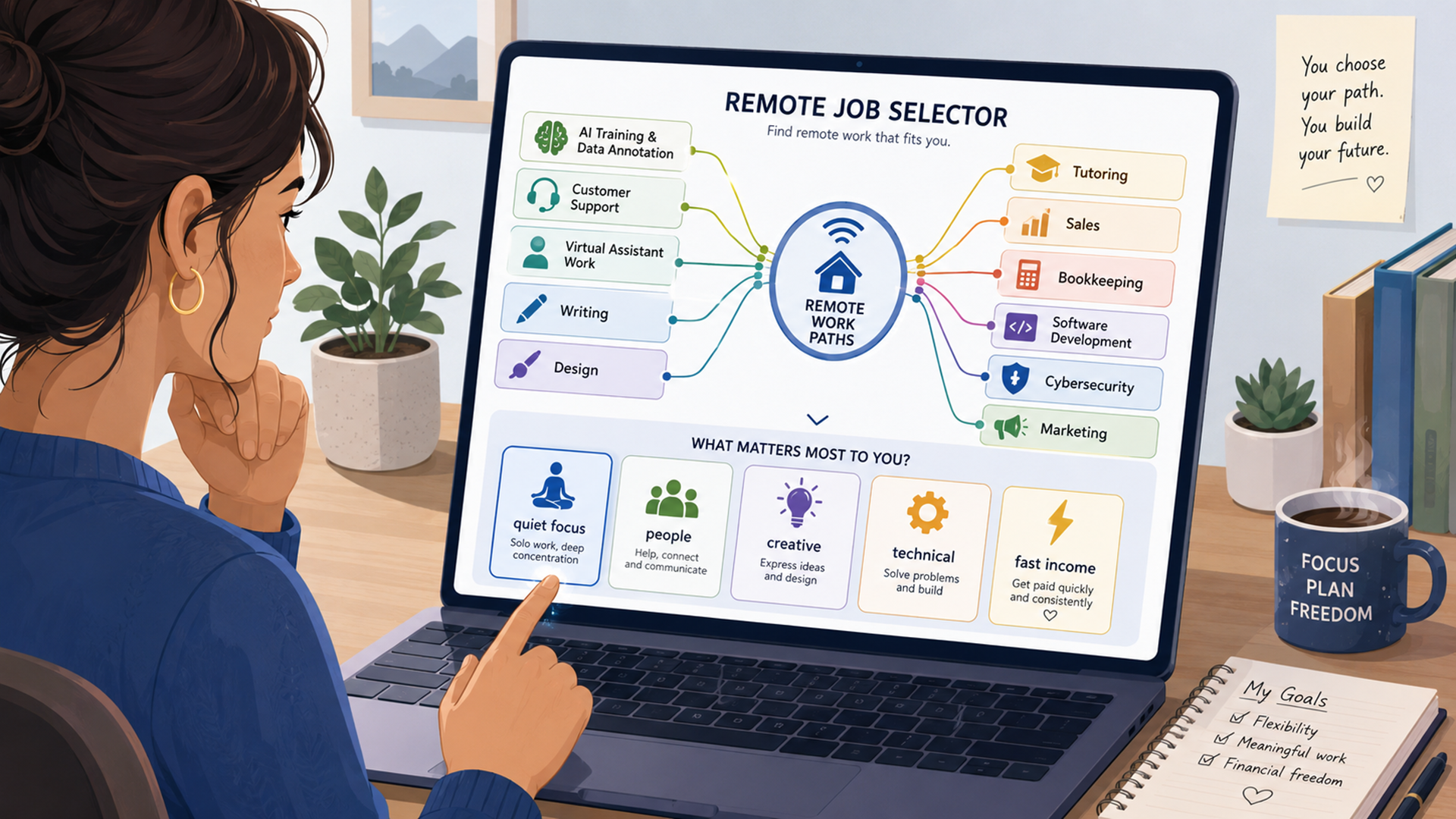
Start With Work Style, Not a Job Title
Most people choose remote jobs backward. They start with a title: virtual assistant, data analyst, copywriter, developer, AI trainer, customer support rep. Then they try to force themselves into that role. A better approach is to start with how you actually like to work.
Ask what kind of day you can repeat without hating your life. Do you want fast interaction or quiet focus? Do you want predictable tasks or creative problem-solving? Do you want to talk to customers, manage projects, produce content, review information, or build technical systems? Remote work removes the office, but it does not remove the underlying personality fit of the job.
A person who hates phone calls should be careful with sales, support, and appointment setting. A person who gets bored easily may struggle with data entry, transcription, or repetitive labeling work. A person who loves problem-solving but hates client management may prefer software QA, data analysis, or AI model evaluation over freelancing. The job title matters, but the daily experience matters more.
This is why the best first step is a work-style filter. Once you know the kind of workday that fits you, the job options become much clearer. The selector below is designed to do exactly that.
Use This Interactive Remote Job Selector
This selector works like a small career-fit app inside the article. Instead of showing every question at once, it walks you through one decision at a time. Click the answer that sounds most like you, and the next question appears automatically. At the end, you will see your top remote job families and practical first steps.
The goal is not to tell you that only one job is correct. Most people have two or three realistic paths. For example, someone who wants quiet, flexible work may match with AI training, writing, bookkeeping, or QA testing. Someone who enjoys people and performance-based income may match with customer success, sales, tutoring, or recruiting. Use the results as a starting point, then test one path before committing.
Remote Job Fit Tool
Find the Remote Work Path That Fits You
Answer six quick questions. Your result will recommend remote job families based on work style, skill level, income goals, and comfort with calls or clients.
How do you prefer to spend most of your workday?
Choose the work mode that feels easiest to repeat, not the one that sounds most impressive.
What skill level best describes you right now?
This helps separate fast-start jobs from jobs that require a portfolio, certification, or specialized knowledge.
How fast do you need to earn money?
Some jobs are quick entry points. Others are better long-term bets but require more ramp-up time.
How do you feel about calls, meetings, and live communication?
This is one of the biggest remote job fit issues. Be honest here.
What kind of tasks feel most tolerable to repeat?
A job can be remote and still be miserable if the repeated tasks drain you.
What income path sounds best?
This helps match you with stable roles, flexible side work, freelance paths, or high-ceiling skill tracks.
Your Best Remote Job Matches
Next step: Pick your top result and run a two-week test project before committing. The best remote job is not the one that sounds impressive; it is the one you can repeat consistently.
Use the results as a filter, not a permanent label. If the app points you toward AI training, writing, or bookkeeping, test one small task. If it points you toward customer support, tutoring, or sales, practice real conversations. If it points you toward software, QA, cybersecurity, or automation, build a tiny project. The point is to turn a vague career question into a practical next step.
Remote Job Families and Who They Fit
Remote jobs are easier to understand when grouped by job family. The titles change constantly, but the work patterns stay similar. A “customer experience specialist” may be a support job. A “creator operations assistant” may be a virtual assistant job. An “AI response evaluator” may be data annotation and AI training.
The table below gives a broad map. Use it to see all the options, not just the one that seems obvious.
| Remote job family | Best fit | Common examples | Skill level |
|---|---|---|---|
| AI training and data annotation | Detail-focused people who like quiet, task-based work | AI response evaluator, data labeler, search evaluator, model feedback reviewer, subject-matter AI trainer | Beginner to advanced |
| Customer support | Patient communicators who can handle repetitive questions | Chat support, email support, phone support, technical support, customer experience rep | Beginner to intermediate |
| Virtual assistant and admin | Organized people who like helping businesses run smoothly | Inbox management, scheduling, research, CRM updates, travel booking, operations assistant | Beginner to intermediate |
| Writing and content | People who explain ideas clearly | Blog writer, copywriter, technical writer, SEO writer, newsletter assistant, grant writer | Beginner to advanced |
| Marketing and social media | Creative people who also like metrics | Social media manager, SEO assistant, email marketer, paid ads assistant, content strategist | Intermediate |
| Design, video, and creative | Visual thinkers who like project-based work | Graphic designer, video editor, thumbnail designer, UX/UI assistant, presentation designer | Intermediate to advanced |
| Tutoring and coaching | People who enjoy teaching and feedback | English tutor, test prep tutor, coding tutor, fitness coach, career coach, language teacher | Beginner to advanced |
| Sales and appointment setting | Persuasive communicators who can handle rejection | SDR, appointment setter, closer, account executive, lead generation specialist | Beginner to advanced |
| Bookkeeping and finance ops | Detail-oriented people who like numbers | Bookkeeper, payroll assistant, accounting clerk, QuickBooks specialist, accounts payable assistant | Intermediate |
| Software, QA, and technical work | Problem-solvers willing to learn hard skills | Web developer, software developer, QA tester, no-code automation builder, data analyst | Intermediate to advanced |
| Cybersecurity and IT support | Technical troubleshooters who like systems | Help desk, SOC analyst, security analyst, cloud support, network support | Intermediate to advanced |
| Low-barrier task work | People who need flexible side income quickly | Surveys, testing apps, microtasks, transcription snippets, usability tests | Beginner |
Some of these paths are more durable than others. For example, BLS projects overall employment for software developers, QA analysts, and testers to grow 15% from 2024 to 2034, much faster than the average for all occupations [3]. BLS also reported a May 2024 median annual wage of $133,080 for software developers and $102,610 for software QA analysts and testers [3]. That does not mean everyone should become a developer. It means technical skill-building can pay off if your personality fits the work.
On the other hand, customer support is easier to enter but faces automation pressure. BLS projects customer service representative employment to decline 5% from 2024 to 2034, though it still expects about 341,700 openings per year because of replacement needs [4]. That makes customer support a useful entry point, but not necessarily the best long-term ceiling unless you move into customer success, technical support, operations, or management.
Best Remote Jobs by Skill Level
A good remote career plan should include jobs you can do now and jobs you can grow into. That is especially important if you are changing careers, coming back to work, or trying to escape low-paid local jobs.
Beginner-friendly remote jobs usually require less formal training and give you a faster route to income. Good options include customer support, virtual assistant work, data entry, basic AI data annotation, transcription, content moderation, appointment setting, online tutoring in a subject you already know, and usability testing.
These jobs are best if you need income quickly, have limited experience, or are still figuring out what kind of work fits you. They are also useful bridge jobs. A virtual assistant can become an operations manager. A support rep can become a customer success manager. A data annotator can move into AI evaluation, QA, or domain-specific AI training.
Intermediate remote jobs usually require a portfolio, certification, specialized software knowledge, or proof that you can handle responsibility without close supervision. This category includes bookkeeping, social media management, SEO, email marketing, content writing, copywriting, graphic design, video editing, recruiting coordination, project coordination, online tutoring, QA testing, and no-code automation.
Bookkeeping and accounting-adjacent work can be a strong remote path for detail-oriented people, though the exact role matters. BLS projects bookkeeping, accounting, and auditing clerk employment to decline 6% from 2024 to 2034, partly because automation is changing routine clerical work [5]. But BLS projects accountants and auditors to grow 5% over the same period, with 124,200 openings per year on average [6]. The lesson: routine data entry may shrink, but higher-skill finance work still has demand.
Advanced remote jobs pay more because they solve harder problems. Software development, data analysis, cybersecurity, cloud administration, product management, UX research, technical writing, paid advertising strategy, specialized consulting, and subject-matter AI training all sit here.
AI training deserves special attention because it spans all skill levels. General AI response evaluation may be accessible to strong readers and writers. Specialized AI training may require medicine, law, finance, coding, science, language fluency, or graduate-level expertise. Jivaro’s remote-work platform guides discuss AI training/data work through platforms such as Alignerr and other work-from-home platforms, which can fit people who have knowledge but do not want a traditional job structure. Alignerr’s jobs page advertises expert AI training work paying up to $150 per hour, though availability and acceptance are not guaranteed [7].
Match Your Personality to Remote Work
Personality matters more in remote work than people expect. In an office, the environment creates some structure for you. At home, you have to create more of it yourself. If you choose the wrong remote job, the problem may not be remote work. It may be a mismatch between the work and your temperament.
If you are introverted and detail-focused, consider AI training, data annotation, writing, bookkeeping, QA testing, research, transcription, analytics, or technical documentation. These jobs usually reward concentration and accuracy more than constant social energy.
If you are social and persuasive, look at customer support, customer success, sales, appointment setting, recruiting, account management, tutoring, coaching, or community management. These jobs are better if conversation gives you energy rather than drains you.
If you are creative but not highly technical, consider content writing, social media, design, video editing, podcast support, email marketing, newsletter production, or brand assistance. These can start small and grow into high-value freelance or agency work.
If you like systems and problem-solving, look at software development, QA testing, no-code automation, data analytics, cybersecurity, IT support, operations, or project management. These jobs usually reward people who enjoy figuring out why something broke and how to make it better.
Remote Jobs to Avoid If They Do Not Fit You
Some remote jobs sound attractive because they are easy to market online. That does not mean they fit you. Appointment setting, for example, can be lucrative if you are comfortable with rejection, scripts, follow-ups, and performance pressure. If rejection ruins your day, it may become miserable fast.
Customer support is another example. It can be a solid entry point, but it requires emotional regulation. You may deal with angry customers, strict metrics, scripted responses, and repetitive issues. If you want quiet independent work, chat or email support may be tolerable, but phone-heavy roles could burn you out.
Freelance writing and design sound flexible, but they require client management, revisions, marketing, and deadlines. If you want someone else to hand you tasks, a platform or employee role may fit better at first. If you like ownership and can handle uncertainty, freelancing can be excellent.
Data annotation and AI evaluation can be perfect for some people and painfully boring for others. The work may be repetitive, guidelines can be strict, and tasks can come and go. It works best as either a flexible side income or a specialized expert path, not a guaranteed full-time salary unless the platform or employer offers stable hours.
How to Test a Remote Job Before Committing
Before going all-in on a remote job path, run a two-week test. This keeps you from investing months into a career that sounds good but feels wrong.
Choose one job family and complete a small sample project. If you are considering writing, publish two articles or rewrite landing page copy. If you are considering VA work, organize a mock inbox and calendar system. If you are considering data annotation, try a legitimate task platform or AI evaluation application. If you are considering coding, build a tiny web app. If you are considering support, practice handling 20 mock customer tickets.
Then evaluate the experience honestly:
- Did the work make time pass quickly or slowly?
- Did you feel drained in a bad way or challenged in a good way?
- Did the tasks match your natural strengths?
- Could you imagine doing this for 20 hours per week?
- What skill would increase your pay the fastest?
- Would you rather do this as an employee, freelancer, or side hustle?
This test matters because remote work removes some friction but not all friction. A bad job is still a bad job at home. A good-fit job can feel dramatically better remotely because you control your environment, breaks, and energy.
Build a Simple Upgrade Path
The best remote workers do not only ask, “What can I do now?” They ask, “What does this turn into?” That is how a low-paying first remote job becomes a stepping stone instead of a trap.
A customer support rep can become a technical support specialist, customer success manager, QA tester, or product operations coordinator. A virtual assistant can become an executive assistant, operations manager, project coordinator, or automation specialist. A data annotator can become an AI evaluator, prompt evaluator, QA analyst, or subject-matter AI trainer. A writer can become an SEO strategist, copywriter, technical writer, or content lead.
The upgrade path usually requires one of four things: a portfolio, a credential, measurable results, or a niche. A portfolio proves you can do the work. A credential helps in fields like bookkeeping, IT, cybersecurity, or project management. Measurable results help in marketing, sales, and operations. A niche helps almost everywhere.
If you are starting from zero, pick a path that pays something now and teaches something valuable later. For example, customer support teaches product knowledge and communication. VA work teaches operations. AI annotation teaches guidelines and quality control. Writing teaches research and communication. QA testing teaches software thinking. These skills compound if you choose deliberately.
The Best Remote Job Is the One You Can Repeat
The right remote job should match your energy, skills, and life constraints. If you need quick income, start with beginner-friendly work such as customer support, VA tasks, tutoring, data annotation, task platforms, transcription, or appointment setting. If you want a stronger long-term ceiling, build toward software, QA, marketing, bookkeeping, cybersecurity, design, analytics, or specialized AI training.
Do not chase only the job title. Chase the workday. The best remote job is the one you can repeat without constantly fighting your own personality. Use the selector, pick two job families, run a two-week test, and then commit to one upgrade path for the next 90 days. Remote work rewards people who combine self-awareness with skill-building.
References
- U.S. Bureau of Labor Statistics. “American Time Use Survey — 2024 Results.”
- Pew Research Center. “Many remote workers say they’d be likely to leave their job if they could no longer work from home.”
- U.S. Bureau of Labor Statistics. “Software Developers, Quality Assurance Analysts, and Testers.”
- U.S. Bureau of Labor Statistics. “Customer Service Representatives.”
- U.S. Bureau of Labor Statistics. “Bookkeeping, Accounting, and Auditing Clerks.”
- U.S. Bureau of Labor Statistics. “Accountants and Auditors.”
- Alignerr. “Jobs.”