Best Countries to Live Abroad as a Remote Worker
A remote job changes the math of where life can happen. If income arrives in U.S. dollars, British pounds, euros, Swiss francs, Canadian dollars, or another strong currency, the same paycheck can feel completely different depending on where it is spent. Rent, food, healthcare, transit, childcare, and entertainment all become part of a bigger question: where can a remote worker live well and keep more of their money?
The answer is not always the cheapest country. Cheap rent means little if the internet is unreliable, healthcare is hard to access, banking is painful, or the time zone makes every meeting happen at midnight. A good remote-work destination needs a mix of affordability, safety, infrastructure, visa practicality, cultural fit, and enough daily comfort that saving money does not feel like a punishment.
This guide compares several strong options for remote workers who want to live abroad: Japan, Thailand, Colombia, Brazil, Uruguay, Mexico, Portugal, and Spain. Each country offers a different version of the same opportunity. Some are best for savings. Some are best for lifestyle. Some are better for families, long stays, or people who want structure and safety. The point is not to crown one winner. The point is to help you choose the place where your income, work schedule, and lifestyle actually fit.

How to Think About Living Abroad on a Strong Currency
The first mistake people make is comparing countries only by average monthly cost. That can be useful, but it is incomplete. A $1,500 monthly lifestyle in one country may be comfortable, while the same number somewhere else may mean poor housing, weak internet, or constant tradeoffs. Cost matters most when it is tied to quality of life.
A better framework is to separate currency advantage from relocation fit. Currency advantage asks how far your paycheck goes after rent, food, transit, insurance, taxes, and basic comforts. Relocation fit asks whether you can legally stay, work remotely, maintain your job schedule, access healthcare, feel safe, and build a normal life. Both matter. A place can be cheap and still be wrong for you.
Cost-of-living databases such as Numbeo can help compare countries, but they should be treated as directional rather than absolute because prices vary by city, neighborhood, season, and lifestyle [1]. Quality-of-life rankings are also useful but imperfect because they compress many variables—healthcare, pollution, safety, purchasing power, commute times, and climate—into a single index [2]. Use them as filters, not final answers.
For remote workers earning in strong currencies, the biggest savings usually come from three categories: housing, healthcare, and daily services. A $4,000 monthly income may feel tight in London, Toronto, or New York. In Chiang Mai, Medellín, Florianópolis, or parts of Mexico, it can support a much more relaxed lifestyle. In Tokyo or Barcelona, it may not create dramatic savings, but it can buy a high-quality life with better transit, food, safety, and cultural depth.
Quick Comparison of Remote Worker Destinations
The table below is a planning tool, not a final verdict. It groups destinations by practical fit for remote workers earning externally in USD, GBP, EUR, CHF, CAD, or AUD. Visa rules change often, and consulates may interpret requirements differently, so every serious relocation plan should include a fresh check with official sources or an immigration professional.
| Country | Best for | Cost feel for strong-currency earners | Visa / stay angle | Main tradeoff |
|---|---|---|---|---|
| Japan | Safety, infrastructure, food, culture | Medium to high; cheaper outside Tokyo | Digital nomad status up to 6 months; income requirement of at least ¥10 million annually [3] | Short stay and high income threshold |
| Thailand | Low cost, beaches, Chiang Mai/Bangkok nomad scene | Low to medium | Destination Thailand Visa has 5-year validity and 180-day stays per entry [4] | Heat, bureaucracy, and tourist/visa rule changes |
| Colombia | Savings, timezone fit for U.S., city life | Low to medium | Digital Nomad Visa up to 2 years; income around 3 Colombian minimum wages [5] | Safety varies sharply by city/neighborhood |
| Brazil | Beaches, culture, large cities, moderate visa bar | Medium; cheaper outside Rio/São Paulo hotspots | Digital nomad visa route via VITEM XIV for foreign remote workers [6] | Safety, bureaucracy, and city-by-city cost swings |
| Uruguay | Stability, safety, South America with structure | Medium to high for South America | Digital nomad permit for 6 months, extendable another 6 months [7] | Less cheap than Colombia/Brazil/Argentina |
| Mexico | U.S. timezone, proximity, established expat hubs | Low to medium, but rising in top cities | Temporary resident visa often used by remote workers; income/savings rules vary by consulate [8] | Popular cities have become expensive |
| Portugal | EU lifestyle, safety, long-term residency path | Medium; Lisbon/Porto pricier now | D8 remote-work visa tied to 4× Portuguese minimum wage income [9] | Housing pressure and rising costs |
| Spain | Lifestyle, healthcare, culture, EU access | Medium; major cities rising | Digital nomad visa generally tied to 200% of Spanish minimum wage [10] | Taxes and bureaucracy can be complex |
Use this table as a shortlist builder. If the goal is saving aggressively, Thailand and Colombia usually deserve a first look. If the goal is quality of life with strong infrastructure, Japan, Spain, and Portugal stand out. If the goal is a South American base with stability, Uruguay deserves attention even though it is not the cheapest choice.
Japan: Best for Safety, Infrastructure, and High-Quality Living
Japan is not the cheapest remote-work destination on this list, but it may offer the best blend of safety, transit, food, healthcare access, cultural depth, and reliable infrastructure. For someone earning in dollars, pounds, euros, or francs, Japan can feel surprisingly reasonable outside the most expensive parts of central Tokyo. Osaka, Fukuoka, Sapporo, Nagoya, Sendai, and smaller regional cities can offer a high standard of living without Tokyo-level housing costs.
The catch is the visa. Japan’s digital nomad status is designed for remote work for overseas companies or clients, with a stay of up to six months and no extension under that status [3]. Japan’s Immigration Services Agency states that applicants must have an annual income of at least ¥10 million at the time of application [3]. That threshold makes Japan more suitable for higher earners than budget nomads.
Japan works especially well for people who want order, low crime, dependable transit, excellent food, and a culture that rewards routine. It is also friendly to deep work. Internet is generally strong, cafés are common, and coworking spaces are easy to find in major cities. The main lifestyle adjustment is language. English support exists, but bureaucracy, banking, housing contracts, and neighborhood life become much easier with Japanese ability or local support.
For a remote worker earning a strong salary, Japan is less about maximizing savings and more about buying a stable, comfortable, highly functional life. It is a strong choice for a six-month chapter, a testing period, or a higher-income remote worker who wants daily life to feel safe and polished.
Thailand: Best for Low-Cost Comfort and Nomad Infrastructure
Thailand remains one of the most practical remote-work destinations because it combines affordability, good internet, established expat communities, strong food culture, and multiple lifestyle options. Bangkok suits people who want energy and business infrastructure. Chiang Mai is still a classic lower-cost remote-work hub. Phuket, Koh Samui, Krabi, and other coastal areas offer beach living at different budget levels.
Thailand’s Destination Thailand Visa, often called the DTV, is a major reason the country belongs near the top of any remote-worker list. Royal Thai Embassy materials describe the visa as valid for five years, with stays of 180 days per entry and an option to extend a stay once for up to another 180 days [4]. That gives remote workers more breathing room than short tourist entries.
The financial advantage can be substantial. A remote worker earning in USD, GBP, or EUR may find that rent, food, local transport, massages, gyms, and everyday services cost far less than in North America or Western Europe. This can create real savings even while improving lifestyle. Thailand is one of the few places where a mid-range remote salary can support both comfort and meaningful savings if spending is controlled.
The tradeoffs are heat, visa bureaucracy, and the temptation to spend more than planned in tourist zones. Thailand is affordable, but it is easy to burn money on islands, imported goods, nightlife, and constant travel. For savings, choose a base city, rent monthly, avoid tourist-priced housing, and build a normal routine.
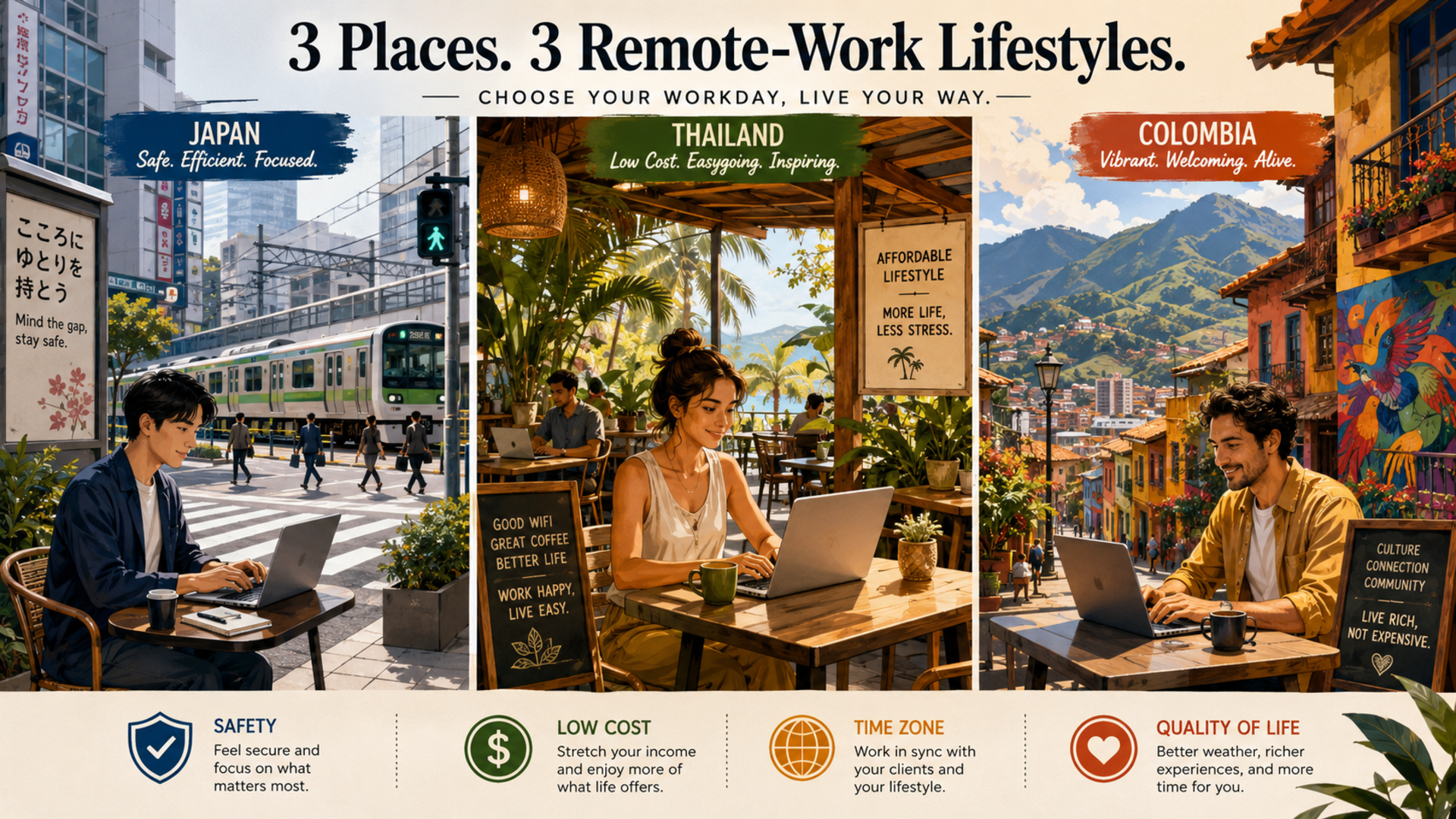
Colombia: Best for U.S. Time Zones and Big-City Value
Colombia is one of the strongest options for remote workers who need to stay aligned with U.S. business hours. Medellín, Bogotá, Cali, and coastal cities each offer different versions of the remote-work lifestyle. Medellín is the best-known nomad hub thanks to climate, coworking, nightlife, and relatively strong infrastructure. Bogotá offers a bigger professional environment and cooler weather. Smaller cities may stretch money further.
Colombia’s Digital Nomad Visa is specifically designed for people working remotely for foreign companies, foreign businesses, or digital ventures. Colombia’s Foreign Ministry states that applicants must show minimum income equivalent to three Colombian legal monthly minimum wages during the previous three months, carry health coverage in Colombia, and avoid working for a Colombian employer under that visa [5]. The visa can be valid for up to two years [5].
For people paid in strong currencies, Colombia can offer a large lifestyle upgrade. Rent, food, local transport, and personal services are often much cheaper than in major U.S., Canadian, or Western European cities. A remote worker who could barely save in Miami, London, or Toronto may be able to live comfortably and still set aside money in Medellín or Bogotá.
Safety is the main caveat. Colombia is not a place to evaluate by country-level averages alone. Neighborhood choice, local habits, transport decisions, and awareness matter. Many remote workers live well there, but the gap between safe and unsafe areas can be large. If Colombia is on your list, visit first, stay in a reputable neighborhood, and learn local security norms before committing.
Brazil: Best for Lifestyle Variety and Culture
Brazil offers a different kind of remote-work value: scale, energy, beaches, music, food, and regional variety. São Paulo works for business and serious career networks. Rio de Janeiro offers dramatic scenery and culture. Florianópolis is popular with tech and lifestyle-focused remote workers. The Northeast can be cheaper and warmer, with cities like Recife, Fortaleza, and Salvador offering coastal living at lower costs than Rio’s prime neighborhoods.
Brazil has a digital nomad visa category under VITEM XIV, and official Brazilian consular materials describe it as a route for immigrants who can work remotely with information and communication technologies for a foreign employer or client [6]. Secondary visa guides report typical financial requirements of $1,500/month in foreign income or $18,000 in savings, but applicants should verify the latest requirement with the relevant consulate because Brazilian processing can vary by location [6].
For strong-currency earners, Brazil can be excellent if you choose the right city and neighborhood. Cost savings can be meaningful, especially outside premium areas. Healthcare access can be good in major cities, private services may be affordable compared with the U.S., and the lifestyle can be rich. The time zone is also workable for many North American and European schedules.
The tradeoff is complexity. Safety, bureaucracy, language, taxes, and infrastructure differ widely by region. Brazil rewards people who do homework. It is not the simplest option for a first move abroad, but for remote workers who want culture, warmth, and a large-country feel, it can be one of the most rewarding.
Uruguay: Best for Stability in South America
Uruguay is often overlooked because it is not the cheapest country in South America. That is exactly why it belongs here. The country offers a calmer, more stable environment than many cheaper alternatives, with a favorable time zone for the Americas, good beaches, solid institutions, and a lifestyle that appeals to people who value safety and predictability over bargain-hunting.
Uruguay offers a digital nomad permit that allows remote workers to stay for up to six months and extend for another six months [7]. Official-facing Uruguay materials state that applicants must work independently or for a foreign company, and that the permit does not allow local employment on a Uruguayan payroll [7]. The process is relatively simple compared with many digital nomad visa systems, although extension requirements can include records and vaccination documentation [7].
For a remote worker paid in dollars or euros, Uruguay can provide a strong quality-of-life base, but it may not generate the same savings as Colombia, Thailand, or parts of Brazil. Montevideo is comfortable but not especially cheap. Punta del Este can be expensive, especially seasonally. Smaller towns can be more affordable but may offer fewer networking and coworking options.
Uruguay is best for remote workers who want South America without as much volatility. It is less of a “maximize savings” destination and more of a “live comfortably with fewer surprises” destination. For some people, that trade is worth it.
Mexico: Best for U.S. Proximity and Time Zone Fit
Mexico remains one of the easiest countries for North American remote workers to imagine because it is close, culturally rich, and aligned with U.S. time zones. Mexico City, Guadalajara, Mérida, Oaxaca, Puebla, Querétaro, Playa del Carmen, and San Miguel de Allende all attract different remote-worker profiles. Some are urban and creative. Some are quieter and family-friendly. Some are now expensive enough that the old “cheap Mexico” stereotype no longer applies.
Mexico does not have a dedicated “digital nomad visa” in the same way some countries do, but many remote workers use temporary residency if they meet financial solvency requirements. Mexican consulate guidance varies by location, and one 2026 consulate page listed high income thresholds for temporary resident applications [8]. Other specialist sources also warn that savings or income requirements vary significantly by consulate [8].
The appeal is clear. Someone earning in USD can often reduce costs without dealing with severe time-zone strain. Flights back to the U.S. are relatively easy. Food culture is exceptional. Coworking and expat infrastructure are mature in major hubs. The downside is that popular places have become more expensive, and housing pressure has created local resentment in some neighborhoods.
Mexico is best for people who want a less dramatic relocation: close to the U.S., familiar enough for a first move, but still capable of delivering meaningful cost savings if they avoid the most inflated expat zones.
Portugal and Spain: Best for EU Lifestyle, Not Maximum Savings
Portugal and Spain remain attractive for remote workers who want European quality of life, healthcare access, culture, walkable cities, and possible long-term residence pathways. They are not the cheapest options on this list, especially in Lisbon, Porto, Barcelona, Madrid, Valencia, and coastal hotspots. But they offer a version of life many remote workers find worth paying for.
Portugal’s D8 remote-work visa is tied to proof of foreign remote income. Current 2026 guidance from major visa specialists describes the income requirement as four times Portugal’s minimum wage, or about €3,680/month based on a €920 minimum wage [9]. Spain’s digital nomad visa generally requires income of 200% of Spain’s minimum wage, with 2026 figures commonly reported around €2,850/month for the main applicant [10].
The money advantage in Portugal and Spain depends heavily on where you are coming from. A remote worker leaving New York, London, Zurich, or San Francisco may still save money in many Spanish or Portuguese cities. A worker leaving a mid-cost U.S. city may find the savings less dramatic. The real gain may be lifestyle: public transit, food, community, healthcare, travel access, and a slower pace.
These countries are best for remote workers who want Europe and can meet the income requirements comfortably. They are less ideal for someone whose primary goal is the lowest monthly burn rate. A cheaper rent number in Thailand or Colombia may beat them. A richer life rhythm in Valencia, Seville, Porto, or Braga may still make them the better choice for the right person.
How to Pick the Right Country for Your Work and Budget
The best country depends on how you actually work. A remote worker with U.S. clients should take time zones seriously. Colombia, Mexico, Brazil, and Uruguay are much easier for U.S. business hours than Japan or Thailand. A remote worker serving European clients may find Portugal, Spain, Uruguay, and parts of Brazil easier than Southeast Asia. A worker with asynchronous tasks, writing, development, design, or AI training gigs may have more freedom.
Start with monthly income after taxes. Then estimate realistic housing, health insurance, transportation, food, coworking, visa costs, flights home, and emergency savings. Do not build the plan around best-case rent. Use a number that includes comfort. If the budget only works in the cheapest room in the cheapest district, the move may not be stable.
Next, think about friction. Can you speak the language? Can you handle bureaucracy? Do you need medication, healthcare specialists, childcare, or stable banking? Do you need to call clients every day? Will you be lonely without a large expat or local community? These questions matter as much as rent.
A simple decision framework helps:
- Choose Thailand or Colombia if the priority is stretching income and living comfortably on a moderate remote salary.
- Choose Japan if safety, infrastructure, food, and cultural experience matter more than maximum savings.
- Choose Mexico if U.S. proximity, time zones, and easier travel back home matter.
- Choose Brazil if lifestyle, culture, beaches, and big-country variety appeal, and you can tolerate more complexity.
- Choose Uruguay if stability and safety in South America matter more than low cost.
- Choose Portugal or Spain if EU lifestyle and longer-term residence pathways are worth higher costs.
What to Check Before You Move
A move abroad should begin with a test stay. Spend three to six weeks in the city before signing a long lease or applying for a longer visa. Work normal hours. Buy groceries. Use local transit. Test internet at different times of day. Try the neighborhood at night. Visit clinics, coworking spaces, and banks. A vacation tells you whether a place is exciting. A test stay tells you whether life works.
Then verify legal and tax details. Digital nomad visas often prohibit local employment. Some require private insurance, criminal background checks, apostilles, translations, minimum income proof, or bank statements. Tax residency can begin sooner than expected, and U.S. citizens generally still have U.S. filing obligations even while abroad. None of this should stop a move, but it should be planned.
Also think about your work setup. If you depend on client platforms, employer tools, or region-sensitive websites, you may need privacy and access tools. Jivaro’s guide to affordable proxy providers explains proxy use cases for geo-testing and multiple browser profiles, while the broader VPN/proxy distinction is helpful for remote workers using public Wi-Fi or working across countries [12]. Keep the setup legal and compliant with employer policies.
The final step is a savings plan. Decide before moving how much extra money should be saved each month. If the move reduces your cost of living by $1,000 but your lifestyle inflates by $1,000, the financial benefit disappears. The goal is not just to live somewhere beautiful. It is to use location flexibility to create a better life and a stronger balance sheet.

Choose a Place That Fits Your Money and Your Life
Remote work gives people a new kind of bargaining power. It lets a worker separate income from geography, and that can make life cheaper, calmer, richer, or more adventurous depending on the place chosen. But the best destination is not automatically the cheapest one. It is the place where your income, visa options, work hours, health needs, social life, and daily habits line up.
Japan, Thailand, Colombia, Brazil, Uruguay, Mexico, Portugal, and Spain all offer compelling versions of remote life. Some maximize savings. Some maximize safety. Some offer cultural depth, strong time-zone fit, or a path toward longer residence. The smart move is to start with your non-negotiables, run the money, test the city, and treat the first stay as research rather than a permanent leap.
If you already earn remotely, pick three countries from this guide and price a real month in each: rent, health insurance, coworking, food, transit, flights, taxes, and a savings target. The right answer usually becomes clearer once the fantasy meets the spreadsheet.
References
- Numbeo. “Cost of Living Index by Country 2026.”
- Numbeo. “Quality of Life Index by Country 2026.”
- Ministry of Foreign Affairs of Japan and Immigration Services Agency of Japan. “Specified Visa: Designated Activities (Digital Nomad)” and “Status of Residence of Designated Activities.”
- Royal Thai Embassy. “DTV Visa (Destination Thailand Visa).”
- Ministerio de Relaciones Exteriores de Colombia. “Visa V Nómadas Digitales.”
- Gov.br / Brazilian consular materials. “Digital Nomad Visa (VITEM XIV)” and supporting 2026 visa guidance.
- Live in Uruguay / Uruguay official entry procedures. “Digital Nomad Permit.”
- Consulado de México and Mexperience. “Temporary Resident Visa” and “Financial Criteria for Legal Residency in Mexico 2026.”
- Get Golden Visa / NTL International. “Portugal D8 Digital Nomad Visa 2026.”
- Citizen Remote / Spain digital nomad visa guidance. “Spain Digital Nomad Visa 2026.”
- Jivaro. “Remote Work Abroad: How Proxies Help You Live Cheaper.”
- Jivaro. “Best Platforms for Well-Paid Work-From-Home Jobs” and “Best Affordable Proxy Providers.”