PewDiePie Odysseus Explained: What Is Known About the AI Release

PewDiePie Odysseus is best treated as an emerging AI-project label, not a fully documented public product launch. Publicly available sources reviewed for this article verify Felix “PewDiePie” Kjellberg’s recent AI work — including a fine-tuned Qwen-based model, a self-hosted ChatOS setup, an AI voting “council” and a YouTube cleanup extension — but they do not yet clearly verify an official public download page, repository or standalone release page named “Odysseus.”
That distinction matters because search interest around “PewDiePie Odysseus” suggests people are looking for a simple answer: what did PewDiePie release, and what is it? The safest answer, based on the public record as of June 2, 2026, is that Odysseus appears to sit inside PewDiePie’s broader creator-led AI experimentation rather than a conventional game, YouTube series or mainstream app launch.
Verification note: A product-release story would normally rely on an official project page, repository, model card, store listing or announcement post. Those public materials were not clearly available for a standalone “Odysseus” release during this review, so the article below separates confirmed facts from reasonable interpretation.
What can be verified about PewDiePie Odysseus
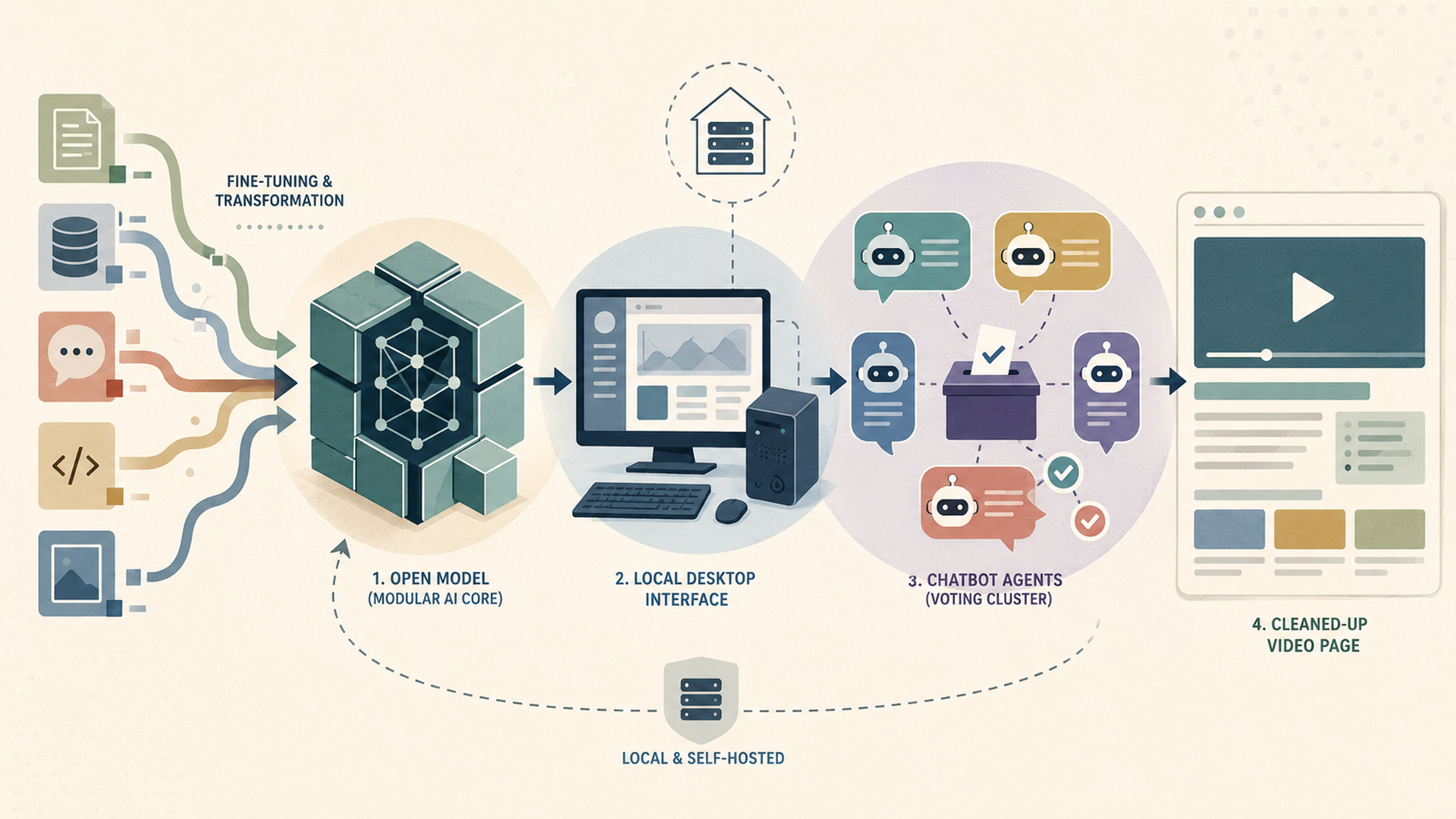
The clearest verified context is PewDiePie’s recent shift into local AI building. In late 2025, Tom’s Hardware reported that Kjellberg had built a custom AI workstation and a web interface called ChatOS, using multiple GPUs and open models to run AI locally rather than relying only on cloud chatbots. The report described his setup as part hobby project, part self-hosted AI lab, with features such as search, audio, memory and retrieval over local information. Tom’s Hardware
PC Gamer separately covered PewDiePie’s AI “council,” a system in which multiple local models could respond, vote and be ranked. That work matters for Odysseus because it shows the creator was not simply using consumer AI tools; he was experimenting with model orchestration, local inference and custom workflows. PC Gamer
In February 2026, Times of India reported on PewDiePie’s claim that he had fine-tuned an AI model built on Qwen 32B, with a focus on coding-style output and benchmark comparisons. The article noted that the model was not built from scratch; it was a customized version of an existing open model family. Times of India
In March 2026, Times of India also reported that PewDiePie had used his own AI workflow to create a browser extension aimed at cleaning up YouTube by removing Shorts, suggested videos and other distracting page elements. That report described a practical output from his AI setup: not just a chatbot, but software generated or assisted by the AI system. Times of India
What Odysseus appears to be
If “Odysseus” is the name attached to PewDiePie’s latest release, the available evidence points toward an AI project or AI-assisted software workflow, not a traditional entertainment release. It appears closer to a home-built local AI stack: a combination of open-source or open-weight models, local hardware, custom interface work, model fine-tuning and software-building experiments.
That would make Odysseus less like a single finished app and more like a named project inside PewDiePie’s AI-building arc. The ingredients publicly associated with that arc include a Qwen-based coding model, local model hosting, multiple agents debating or voting, and software outputs such as the YouTube cleanup extension.
Qwen is a real open model family used by developers for coding and general AI tasks. The official Hugging Face model card for Qwen2.5-Coder-32B-Instruct describes it as part of the Qwen2.5-Coder series, with code generation, code reasoning and code-fixing capabilities. That does not prove Odysseus is identical to Qwen, but it helps explain the type of model infrastructure PewDiePie’s reported work has been built around. Hugging Face
| Question | What is confirmed | What remains unclear |
|---|---|---|
| Is Odysseus a confirmed public product? | PewDiePie’s broader AI work is well documented across public reporting. | A standalone official Odysseus release page, repository or download listing was not clearly verified. |
| Is it a game? | Recent reporting points more strongly to AI tools, local models and coding experiments. | No reliable public source checked here clearly establishes Odysseus as a traditional game release. |
| Is it an AI model? | PewDiePie has been reported to fine-tune a Qwen-based model and run AI locally. | It is not clear whether Odysseus is the name of a model, an app, a workflow or a broader project. |
| Is it connected to YouTube? | PewDiePie reportedly used his AI system to make a browser extension that cleans up YouTube’s interface. | It is not clear whether Odysseus specifically refers to that extension or a separate project. |
| Can people download it? | There is public reporting about the experiments and outputs. | No clearly verified official public download source for “Odysseus” was found in the available public record. |
How the AI project fits PewDiePie’s current direction
Odysseus also fits a broader change in PewDiePie’s public output. PC Gamer reported in November 2025 that Kjellberg had said he was “done” with games for the moment and was spending more time on learning, hobbies and technical projects. The same period included videos and reports about hardware, local AI and software experimentation. PC Gamer
That makes the Odysseus discussion easier to understand. PewDiePie’s AI work is not coming out of nowhere; it follows a creator who has gradually shifted from daily internet entertainment toward selective projects, family privacy and technical curiosity. Times of India reported in May 2026 that Kjellberg planned to end his monthly family vlog series in September 2026, citing privacy for his son as a major reason. Times of India
In that context, Odysseus can be read as part of a creator-economy transition: a major YouTuber using his audience, technical curiosity and local hardware setup to explore software creation. Rather than launching a polished consumer product through a company, the project appears to belong to a looser category of creator-built AI experiments.
What Odysseus is not, based on available evidence
First, Odysseus should not be described as a confirmed game unless a stronger primary source says so. PewDiePie became famous through gaming content, but his recent public AI work points in a different direction.
Second, it should not be described as an official YouTube product. The reported YouTube cleanup tool was framed as PewDiePie’s own AI-assisted fix for the platform experience, not as a Google or YouTube release.
Third, it should not be described as a from-scratch frontier AI model. Public reporting around PewDiePie’s AI model says it was based on an existing model family and then fine-tuned or adapted. That is still technically meaningful, but it is different from training a large model entirely from zero.
Finally, benchmark claims should be handled carefully. Creator videos can show experiments, demos and results, but independent validation requires reproducible benchmarks, public model weights or code, hardware details, evaluation settings and third-party testing.
What to watch next
The next step is whether PewDiePie or collaborators publish a clear Odysseus page, repository, model card or download link. Those materials would answer the most important open questions: what the project is called, what it does, what license it uses, whether it can run locally, what hardware it needs and whether anyone outside PewDiePie’s own setup can test it.
A credible release page would also clarify safety and privacy details. If Odysseus touches YouTube browsing, personal data, local files, model memory or browser permissions, users would need to know what information it can access and whether anything leaves the device.
Until then, the most accurate description is cautious: PewDiePie Odysseus appears to refer to an AI-focused release or project connected to Kjellberg’s recent self-hosted AI experiments, but the public record verifies the surrounding AI work more clearly than it verifies Odysseus as a standalone public product.
FAQ
What is PewDiePie Odysseus?
PewDiePie Odysseus appears to be an AI-related project label connected to Felix Kjellberg’s recent local AI experiments. Public sources verify the broader AI work, but not a clearly documented standalone Odysseus product page.
Is Odysseus an AI model?
It may be connected to an AI model or AI workflow, but that is not fully confirmed. PewDiePie has been reported to use and fine-tune Qwen-based models, run local AI systems and build software with AI assistance.
Is PewDiePie Odysseus available to download?
No clearly verified official public download page, repository or store listing for “Odysseus” was found in the public sources reviewed for this article.
Is Odysseus the same as PewDiePie’s YouTube cleanup tool?
That is not confirmed. Public reporting verifies that PewDiePie used AI to create a YouTube cleanup extension, but it is unclear whether Odysseus refers to that tool or to a separate AI project.
Did PewDiePie build the model from scratch?
Public reporting says his fine-tuned model was based on Qwen 32B rather than trained entirely from scratch. Fine-tuning can still be significant, but it is different from building a foundation model from zero.
Why is the project getting attention?
It combines PewDiePie’s huge creator profile with a fast-growing trend: individuals running and customizing AI models locally instead of only using large cloud-based chatbots.
References
- Tom’s Hardware — PewDiePie goes all-in on self-hosting AI using modded GPUs
- PC Gamer — PewDiePie creates an AI council and local model workflow
- Times of India — PewDiePie claims his fine-tuned AI model beats ChatGPT-4 and other leading tools
- Times of India — PewDiePie says he “fixed” YouTube using his own AI model
- PC Gamer — PewDiePie says he is done with games for now
- Times of India — PewDiePie ending monthly family vlogs in September 2026
- Hugging Face — Qwen2.5-Coder-32B-Instruct model card