The best fantasy books like Lord of the Rings are not necessarily the books with the most elves, enchanted swords, or detailed maps. Tolkien’s appeal comes from a particular combination: a dangerous journey, unlikely companions, ancient history, morally serious stakes, memorable landscapes, invented cultures, and the feeling that the story is only one episode in a much older world.
No other series reproduces all of that exactly. Some recommendations below capture the fellowship and quest. Others focus on dragons, mythology, war, lost kingdoms, ancient evil, moral temptation, or vast worldbuilding. The right next book depends on which part of Middle-earth you miss most.
This guide stays spoiler-light. It reveals each series’ opening premise, tone, reading commitment, and major content considerations without explaining later twists or endings.
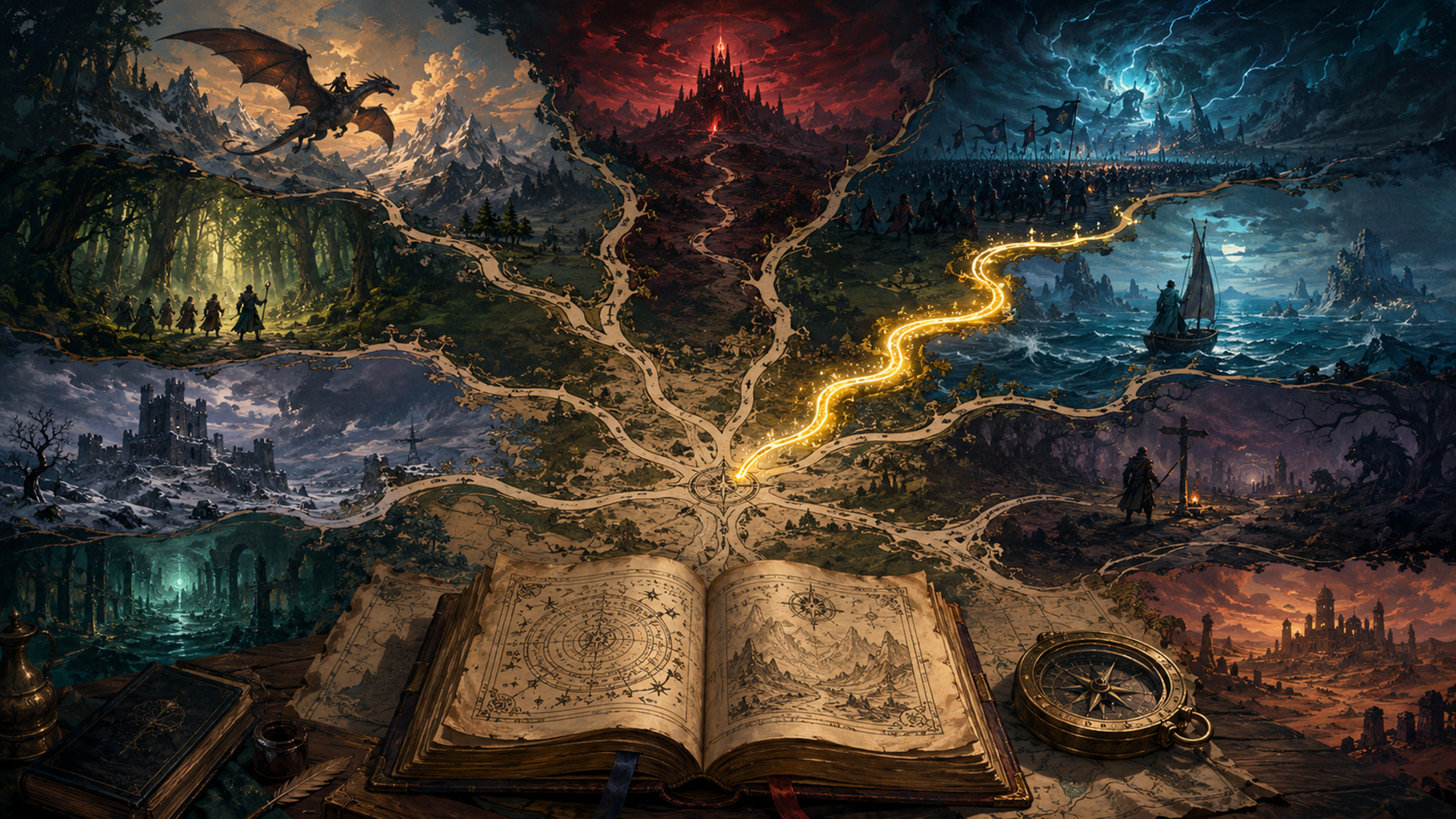
Quick answer: what should a Lord of the Rings fan read next?
Start with The Dragonbone Chair if you want the closest slow-building sense of history, travel, fading magic, and ancient danger. Start with Dragons of Autumn Twilight if you mainly want a fellowship-style party, dragons, warfare, and classic adventure. Start with Eragon if you want an accessible young hero’s journey built around a dragon bond.
Choose The Eye of the World when you want a completed, enormous saga. Choose A Wizard of Earthsea when you want something shorter, quieter, and more philosophical. Choose The Last Wish when you want a morally gray world where monsters are not always the greatest threat. Choose Birthright from Diablo’s Sin War trilogy when you want the darkest possible version of cosmic fantasy.
Best overall starting point: The Dragonbone Chair by Tad Williams is the strongest recommendation here for readers who specifically want another patient, mythic epic with old powers, difficult journeys, divided kingdoms, and an approaching supernatural threat.
What makes a fantasy book feel like Lord of the Rings?
Readers often use “like Lord of the Rings” to mean very different things. Decide which Tolkien element you want before choosing a series.
| If you loved... | Look for... | Best matches in this guide |
|---|---|---|
| The Fellowship | A varied group whose loyalty matters as much as individual power. | Dragonlance, The Wheel of Time, The Chronicles of Prydain, Riftwar. |
| The journey across Middle-earth | Long travel, changing landscapes, ruins, roads, wilderness, and distant cultures. | Memory, Sorrow, and Thorn; The Wheel of Time; Riftwar; The Inheritance Cycle. |
| Ancient history beneath the story | Lost kingdoms, old betrayals, remembered wars, inherited legends, and layered mythology. | Memory, Sorrow, and Thorn; Earthsea; The Wheel of Time; The Stormlight Archive. |
| Dragons and legendary creatures | Dragons as characters, enemies, allies, or remnants of an older age. | The Inheritance Cycle, Dragonlance, Earthsea, Riftwar. |
| The war against an ancient evil | Kingdoms forced to unite against a power returning from the past. | Memory, Sorrow, and Thorn; Dragonlance; The Wheel of Time; Riftwar. |
| Myth, language, and cultural depth | Names, stories, songs, customs, and magic tied to the world’s history. | Earthsea, Prydain, Memory, Sorrow, and Thorn, The Wheel of Time. |
| Moral temptation | Characters facing power, corruption, sacrifice, fear, and compromise. | The Witcher, Earthsea, The Stormlight Archive, Diablo. |
| The darker passages through Moria and Mordor | Ruins, demons, horror, curses, and worlds where victory has a cost. | Diablo, The Witcher, Memory, Sorrow, and Thorn. |
Fantasy series comparison table
This is not a strict ranking. Each series captures a different part of Tolkien’s appeal.
| Series | Start with | Closest Tolkien quality | Tone | Reading commitment |
|---|---|---|---|---|
| Memory, Sorrow, and Thorn | The Dragonbone Chair | Slow mythic build, ancient danger, journeys, divided kingdoms. | Melancholy, immersive, patient. | Original trilogy; long books. |
| The Wheel of Time | The Eye of the World | World-spanning quest, prophecy, cultures, ancient cycles. | Expansive, heroic, increasingly political. | 14 main novels plus a prequel. |
| The Riftwar Cycle | Magician or Magician: Apprentice | Kingdoms at war, young heroes, magic, multiple worlds. | Adventurous, fast-moving, traditional. | Accessible opening saga; much larger connected cycle. |
| Dragonlance Chronicles | Dragons of Autumn Twilight | Fellowship-style party, dragons, war, heroic sacrifice. | Energetic, dramatic, character-driven. | Core trilogy; huge optional shared world. |
| The Earthsea Cycle | A Wizard of Earthsea | Mythic language, moral weight, old magic, dragons. | Poetic, spare, philosophical. | Six core volumes; generally shorter books. |
| The Inheritance Cycle | Eragon | Hero’s journey, dragons, rebellion, elves, ancient order. | Accessible, earnest, adventure-focused. | Four-book core cycle plus later world stories. |
| The Chronicles of Prydain | The Book of Three | Welsh-inspired myth, humble hero, quest companions. | Warm, humorous, increasingly serious. | Five short novels. |
| The Stormlight Archive | The Way of Kings | Epic war, ancient orders, oaths, lost history, huge scale. | Cinematic, emotional, intricate. | Five-book first arc; larger ten-book plan. |
| The Witcher | The Last Wish | Folklore, monsters, war, destiny, moral complexity. | Dark, ironic, political, intimate. | Two opening collections, five-book saga, later standalone/prequel books. |
| Diablo: The Sin War | Birthright | Ancient supernatural war and humanity caught between great powers. | Grim, violent, demonic horror. | Three-book trilogy; additional franchise novels are optional. |
Before leaving Middle-earth, check whether you have more Tolkien to read
If what you really want is more Middle-earth, another author may not satisfy the craving. Read The Hobbit if you started with The Lord of the Rings. Read The Silmarillion for the creation, ancient wars, tragedies, and legends behind the trilogy. Read Unfinished Tales for expanded histories and incomplete narratives.
The Children of Húrin is a stronger choice when you want a complete, tragic narrative set in the First Age. It is much darker than The Hobbit and closer to ancient heroic tragedy than a light adventure.
Once those books no longer feel like enough, move to the series below.
The Inheritance Cycle by Christopher Paolini
Start with Eragon
A farm boy discovers a mysterious stone that hatches into a dragon, drawing him into a struggle against an empire and the fallen Dragon Rider who rules it. The premise is immediately familiar to readers who enjoy hidden heirs, ancient orders, wise mentors, magical languages, resistance movements, and long journeys through a traditional fantasy world.
- Why LOTR fans may like it
- It offers elves, dwarves, dragons, swords, old magic, wilderness travel, a rebellion against a powerful ruler, and a young hero growing into an inherited responsibility.
- How it differs
- The story is more direct, younger, and more focused on the emotional bond between a Rider and dragon. Its magic system and training sequences are explained more explicitly than Tolkien’s magic.
- Tone
- Earnest, adventurous, accessible, and increasingly war-focused.
- Reading commitment
- The original Inheritance Cycle contains four books: Eragon, Eldest, Brisingr, and Inheritance. Later books revisit and expand the same world.
- Best for
- Readers who want dragons at the center of the story, a recognizable hero’s journey, and a smoother transition from young-adult fantasy into longer epics.
- Content note
- Suitable for many teen and adult readers. Expect war, death, torture, captivity, and fantasy violence that intensifies as the series continues.
Choose this first if: your favorite parts of Tolkien were the young hero leaving home, learning from older powers, traveling through strange lands, and discovering that the fate of a much larger world has fallen into his hands.
Diablo: The Sin War trilogy by Richard A. Knaak
Start with Birthright
Diablo is not one conventional novel series. It is a dark-fantasy game franchise supported by tie-in novels, lore books, comics, and related stories. The clearest novel-length entry for a reader interested in its mythology is Birthright, the first book in Richard A. Knaak’s Sin War trilogy.
The trilogy explores the conflict surrounding humanity’s place between the High Heavens and Burning Hells. It gives the franchise’s cosmic war, corrupted faith, demonic influence, and origin mythology room to develop beyond dungeon battles.
- Why LOTR fans may like it
- Both worlds place ordinary people inside an ancient struggle involving powers far older than the present generation. The Sin War also deals with corruption, hidden history, temptation, and supernatural armies.
- How it differs
- Diablo replaces Tolkien’s pastoral beauty and fellowship warmth with religious horror, demonic manipulation, body horror, and a much harsher moral atmosphere.
- Tone
- Grim, apocalyptic, violent, and horror-inflected.
- Reading commitment
- The Sin War is a self-contained trilogy: Birthright, Scales of the Serpent, and The Veiled Prophet. More Diablo novels exist, but they are not required to finish this arc.
- Best for
- Readers who want ancient evil, demons, cursed power, ruined faith, and cosmic warfare rather than a traditional fellowship adventure.
- Content note
- Best for adult or older teen readers comfortable with gore, demonic horror, cruelty, possession, religious manipulation, and bleak imagery.
Choose this first if: Moria, the Nazgûl, Shelob, the Dead Marshes, and the corruption of powerful figures were more compelling to you than the comfort of the Shire.
The Witcher by Andrzej Sapkowski
Start with The Last Wish
Geralt of Rivia is a professional monster hunter moving through a world where folklore, politics, prejudice, war, and personal destiny collide. The best starting point is The Last Wish, a linked short-story collection that introduces Geralt, his work, and several relationships essential to the later saga.
Read Sword of Destiny next before moving to Blood of Elves, the first novel in the five-book central saga. Beginning with the novels skips emotional and narrative groundwork.
- Why LOTR fans may like it
- The series contains ancient races, contested kingdoms, prophecy, war, folklore, dangerous journeys, and characters tied together by loyalty and fate.
- How it differs
- The world is morally gray rather than built around a clear alliance against one central evil. Sapkowski uses irony, political satire, fractured fairy tales, and difficult choices where every available action may cause harm.
- Tone
- Wry, melancholic, violent, intimate, and politically cynical.
- Reading commitment
- Begin with two story collections, continue through the five-book central saga, and treat later standalone or prequel novels as additional reading.
- Best for
- Readers who want monsters rooted in folklore, morally complicated heroes, sharp dialogue, political conflict, and a darker interpretation of fantasy destiny.
- Content note
- Best for adults and mature older teens. The series includes graphic violence, sexual material, war crimes, prejudice, assault themes, and political cruelty.
Choose this first if: you want to question the neat division between heroes and monsters rather than enter another straightforward war between good and evil.
The Riftwar Cycle by Raymond E. Feist
Start with Magician or Magician: Apprentice
The Riftwar story begins in the kingdom of the Isles, where young lives are transformed when a magical rift connects two worlds and turns political tension into invasion. The opening follows characters who grow from ordinary positions into warriors, rulers, magicians, and central figures in a much larger history.
Edition titles can be confusing. In some markets, Magician appears as one novel. In many U.S. editions, it is divided into Magician: Apprentice and Magician: Master. After that, continue with Silverthorn and A Darkness at Sethanon.
- Why LOTR fans may like it
- The opening arc includes kingdoms, warfare, young heroes, castles, elves, dwarves, ancient threats, long journeys, magic, and alliances formed under pressure.
- How it differs
- Riftwar moves faster and places more emphasis on political events, military conflict, magical training, and contact between worlds. Its wider cycle spans generations and connected subseries.
- Tone
- Traditional, energetic, adventurous, and increasingly expansive.
- Reading commitment
- The opening Riftwar Saga is approachable on its own. The complete Riftwar Cycle is much larger, so there is no need to commit to every connected book immediately.
- Best for
- Readers who want classic high fantasy with faster pacing, kingdom-level stakes, major battles, magical development, and a world they can keep exploring for a long time.
- Content note
- Generally suitable for teens and adults, though war, death, captivity, and mature themes become more prominent across the wider cycle.
Choose this first if: you want something recognizably traditional but more plot-driven and easier to move through than Tolkien’s denser historical passages.
Dragonlance Chronicles by Margaret Weis and Tracy Hickman
Start with Dragons of Autumn Twilight
A group of old companions reunites in a world that has lost contact with its gods and is moving toward war. The opening quickly brings together fighters, a ranger, a thief, a dwarf, a conflicted mage, and other allies whose clashing personalities become one of the trilogy’s main strengths.
The core starting sequence is the Chronicles trilogy: Dragons of Autumn Twilight, Dragons of Winter Night, and Dragons of Spring Dawning. The larger Dragonlance setting contains many more books, but the trilogy gives readers a complete and manageable first experience.
- Why LOTR fans may like it
- Dragonlance gives you a fellowship-style group, dragons returning to the world, armies on the move, fallen kingdoms, ancient artifacts, heroic sacrifice, and characters who must cooperate despite deep differences.
- How it differs
- The story reflects its tabletop role-playing roots. It is more episodic, faster, more openly melodramatic, and built around recognizable adventuring roles.
- Tone
- Heroic, dramatic, emotional, occasionally humorous, and full of classic fantasy spectacle.
- Reading commitment
- Begin with the three Chronicles books. Continue into the Legends trilogy only if you want deeper character-focused material.
- Best for
- Readers who want the companionship of the Fellowship, frequent action, dragons, strong character archetypes, and a traditional war between light and darkness.
- Content note
- Suitable for many teen and adult readers. Expect fantasy violence, death, war, grief, and religious themes.
Choose this first if: the Fellowship’s different personalities, arguments, jokes, losses, and loyalty mattered more to you than Tolkien’s appendices and languages.
The Chronicles of Prydain by Lloyd Alexander
Start with The Book of Three
Taran is an Assistant Pig-Keeper who dreams of heroic deeds and quickly discovers that real courage is less glamorous than he imagined. His journey brings him into conflict with dark powers and into friendship with a memorable group of companions.
Prydain draws its names, atmosphere, and imaginative material from Welsh mythology while telling an original coming-of-age story. The series becomes more emotionally serious as Taran matures.
- Why LOTR fans may like it
- It features a humble protagonist, a dangerous quest, an unusual fellowship, dark lords, enchanted weapons, ancient lore, sacrifice, and a landscape shaped by Welsh myth.
- How it differs
- The books are shorter, younger, funnier, and more directly focused on growing up. The worldbuilding is suggestive rather than encyclopedic.
- Tone
- Warm, witty, adventurous, and increasingly bittersweet.
- Reading commitment
- Five concise novels beginning with The Book of Three and ending with The High King. A separate story collection is optional.
- Best for
- Younger readers, families reading together, adults who want a compact classic, and anyone who values character growth over enormous scale.
- Content note
- Appropriate for many middle-grade, teen, and adult readers. Later books include danger, death, grief, sacrifice, and the cost of war.
Choose this first if: you want Tolkien-like moral seriousness and mythic atmosphere in a much shorter, more approachable series.
Memory, Sorrow, and Thorn by Tad Williams
Start with The Dragonbone Chair
Simon is a castle kitchen boy whose ordinary life collapses as a kingdom fractures and an old supernatural danger begins to return. The story starts deliberately, allowing the castle, politics, history, routines, and legends of Osten Ard to become real before the adventure widens.
This is the closest recommendation in the list for readers who want Tolkien’s sense that ruins, songs, names, and royal lines carry centuries of memory. It rewards patience rather than racing toward action.
- Why LOTR fans may like it
- It combines a humble hero, long travel, lost swords, old nonhuman peoples, decaying kingdoms, ancient betrayal, winter landscapes, and a threat misunderstood by the present generation.
- How it differs
- The political conflict is messier, the character viewpoints are more varied, and the psychological development is more modern. The opening is famously gradual.
- Tone
- Melancholy, immersive, patient, historical, and emotionally serious.
- Reading commitment
- The original story is a trilogy. The final novel is extremely long and is divided into two physical volumes in some editions. Later Osten Ard books are optional continuations.
- Best for
- Readers who want the nearest match here to Tolkien’s slow mythic accumulation, travel writing, fading ages, and weight of history.
- Content note
- Best for older teens and adults. Expect war, violence, political cruelty, disturbing imagery, and mature themes.
Choose this first if: you are willing to let a world build slowly and want history, landscape, and legend to matter as much as the immediate plot.
The Wheel of Time by Robert Jordan and Brandon Sanderson
Start with The Eye of the World
Young people from an isolated rural community are forced onto the road when destructive forces find them. What begins as a recognizable flight from danger expands into a continent-spanning story of prophecy, politics, cultures, magic, war, identity, and repeating history.
The first book intentionally offers several Tolkien-like surfaces: a quiet home, mysterious visitors, pursued travelers, an ancient enemy, dangerous roads, and a wider world opening gradually. The series then becomes increasingly distinct.
- Why LOTR fans may like it
- It offers enormous geographic scale, an ensemble cast, old prophecies, different cultures, ancient ruins, magical orders, great battles, and a final struggle against a returning evil.
- How it differs
- The series has a more explicit magic system, more political factions, a much larger viewpoint cast, and a cyclical cosmology. It spends far more time on institutions, social conflict, and long character arcs.
- Tone
- Heroic, expansive, intricate, occasionally humorous, and increasingly political.
- Reading commitment
- Fourteen main novels plus the prequel New Spring. The main series is complete.
- Best for
- Readers who want the largest completed journey in this guide and are ready to live with a cast and world for many books.
- Content note
- Best for teens and adults. Includes warfare, captivity, coercion, torture, sexual references, trauma, and prolonged political conflict.
Choose this first if: your reaction to finishing Tolkien was not “I need another trilogy,” but “I need a world large enough to occupy me for months.”
The Earthsea Cycle by Ursula K. Le Guin
Start with A Wizard of Earthsea
Ged is a gifted young mage whose pride releases a danger he does not understand. His story unfolds across an archipelago where true names, balance, death, dragons, silence, and responsibility matter more than displays of magical force.
Earthsea may be shorter than Tolkien, but it shares his respect for language and the idea that magic should have metaphysical and moral consequences.
- Why LOTR fans may like it
- Earthsea offers ancient words, wise teachers, dragons, voyages, old powers, moral temptation, and a world that feels larger than the scenes directly described.
- How it differs
- The books are compressed, inward, and philosophical. Conflicts are often resolved through self-knowledge, naming, balance, or acceptance rather than military victory.
- Tone
- Poetic, austere, thoughtful, mythic, and emotionally restrained.
- Reading commitment
- Six core volumes, including the story collection Tales from Earthsea. Most individual books are comparatively short.
- Best for
- Readers who loved Tolkien’s languages, songs, old magic, restraint, and moral seriousness more than the battlefield chapters.
- Content note
- Suitable for many teens and adults, but later books address trauma, mortality, oppression, gender, abuse, and difficult social themes.
Choose this first if: you want fantasy that feels old, quiet, and wise rather than enormous and constantly explosive.
The Stormlight Archive by Brandon Sanderson
Start with The Way of Kings
On a world reshaped by supernatural storms, soldiers, scholars, rulers, and damaged survivors become entangled with the return of ancient powers and a lost order of magically bonded warriors.
The series is much more modern in structure than Tolkien. It uses multiple timelines, several major viewpoints, designed magic systems, mysteries, large-scale warfare, and long emotional arcs.
- Why LOTR fans may like it
- It offers enormous history, ancient orders, forgotten oaths, ruined civilizations, legendary weapons, nonhuman peoples, great battles, and heroes confronting a returning threat.
- How it differs
- The magic is more systematic, the action more cinematic, and the world more alien. Mental health, leadership, trauma, and moral promises are central to the character arcs.
- Tone
- Epic, intense, hopeful, emotionally direct, and highly intricate.
- Reading commitment
- The first five-book arc forms the first half of a planned ten-book series. Optional novellas connect some of the main volumes.
- Best for
- Readers who want a modern epic with giant books, elaborate magic, major battles, hidden history, and characters rebuilding themselves through difficult choices.
- Content note
- Best for older teens and adults. Includes warfare, slavery, trauma, depression, suicidal ideation, addiction, grief, and graphic violence.
Choose this first if: you want Tolkien-sized ambition delivered with modern pacing, explicit magic rules, cinematic action, and emotionally vulnerable heroes.
Which fantasy series should you choose by reading mood?
| Your reading mood | Best choice | Why |
|---|---|---|
| I want the closest mythic epic to Tolkien. | Memory, Sorrow, and Thorn | Patient worldbuilding, ancient danger, journeys, lost history, and fading powers. |
| I want a classic party of adventurers. | Dragonlance Chronicles | A varied group, strong personalities, dragons, war, and heroic sacrifice. |
| I want dragons as central characters. | The Inheritance Cycle | The Rider-dragon bond is the emotional and magical center of the story. |
| I want a huge completed saga. | The Wheel of Time | Fourteen main novels, a massive cast, many cultures, and a completed central conflict. |
| I want something short but profound. | Earthsea | Compact books with mythic language, moral depth, and little wasted motion. |
| I want a younger classic. | The Chronicles of Prydain | Five accessible books with humor, Welsh-inspired mythology, growth, and sacrifice. |
| I want traditional fantasy with faster pacing. | The Riftwar Cycle | Kingdoms, magic, invasion, and adventure without Tolkien’s denser prose. |
| I want modern epic spectacle. | The Stormlight Archive | Complex magic, huge battles, mysteries, multiple viewpoints, and emotional character arcs. |
| I want morally gray dark fantasy. | The Witcher | Folklore, political cruelty, sharp dialogue, and difficult choices without easy moral answers. |
| I want demonic horror and cosmic war. | Diablo: The Sin War | Angels, demons, corruption, violent mythology, and a much darker atmosphere. |
Series length, accessibility, and reading difficulty
Length is not the same as difficulty. Earthsea is short but thematically dense. Dragonlance is longer than Prydain but generally faster to read. Memory, Sorrow, and Thorn has only three original novels, but those novels are substantial and deliberately paced.
| Series | Accessibility | Commitment | Best first-book test |
|---|---|---|---|
| The Chronicles of Prydain | Very accessible | Five short books | Finish The Book of Three; the later books become deeper. |
| Dragonlance Chronicles | Accessible | Three-book core | Read Dragons of Autumn Twilight and decide whether the party chemistry works for you. |
| The Inheritance Cycle | Accessible | Four long core books | Read Eragon if you want a youthful dragon-centered adventure. |
| Diablo: The Sin War | Accessible to moderate | Three books | Read Birthright if grim religious horror appeals to you. |
| The Riftwar Cycle | Accessible to moderate | Short opening arc; enormous optional cycle | Treat Magician as the test and ignore the wider reading order until later. |
| The Witcher | Moderate | Two collections, five-book saga, optional later books | Read both opening collections before judging the central saga. |
| The Earthsea Cycle | Accessible prose, deeper themes | Six concise volumes | Read A Wizard of Earthsea slowly rather than expecting constant action. |
| Memory, Sorrow, and Thorn | Moderate to demanding | Three very long novels | Give The Dragonbone Chair time to establish its castle and characters. |
| The Wheel of Time | Moderate | Fourteen main books | Read the first two books if you want to see how the series moves beyond its Tolkien-like opening. |
| The Stormlight Archive | Moderate to demanding | Five-book first arc; ten planned | Expect The Way of Kings to establish several storylines before they converge. |
Age guidance and darker-content notes
Age categories vary by reader, edition, and family. The guide below focuses on tone rather than treating a single age number as universally correct.
| Series | General audience | Notable content |
|---|---|---|
| The Chronicles of Prydain | Middle-grade, teen, and adult | Peril, death, war, grief, and sacrifice, handled without graphic detail. |
| The Inheritance Cycle | Teen and adult | Fantasy combat, torture, captivity, death, and large-scale war. |
| Dragonlance Chronicles | Teen and adult | War, death, grief, monsters, religious conflict, and dramatic sacrifice. |
| Earthsea | Teen and adult | Mortality, trauma, abuse, oppression, grief, and philosophical themes. |
| Riftwar | Teen and adult | War, invasion, death, captivity, political violence, and increasingly mature later material. |
| Memory, Sorrow, and Thorn | Older teen and adult | Violence, disturbing imagery, political cruelty, suffering, and mature themes. |
| The Wheel of Time | Teen and adult | War, captivity, torture, coercion, sexual references, trauma, and political conflict. |
| The Stormlight Archive | Older teen and adult | War, slavery, trauma, depression, suicidal ideation, addiction, and graphic violence. |
| The Witcher | Adult and mature older teen | Graphic violence, sexual content, assault themes, prejudice, war crimes, and political cruelty. |
| Diablo: The Sin War | Adult and mature older teen | Gore, demonic horror, possession, cruelty, religious manipulation, and bleak imagery. |
FAQ
What is the closest fantasy series to Lord of the Rings?
Memory, Sorrow, and Thorn is the closest overall recommendation in this guide because of its slow mythic build, ancient history, long journeys, divided kingdoms, nonhuman peoples, and returning supernatural threat.
What should I read immediately after Lord of the Rings?
Read The Silmarillion if you want more Middle-earth. For a different author, begin with The Dragonbone Chair, Dragons of Autumn Twilight, or Eragon, depending on whether you want mythic depth, fellowship adventure, or dragons.
Which series is best for younger Lord of the Rings fans?
The Chronicles of Prydain is the best younger-reader choice. The Inheritance Cycle is also accessible for many teens who want a longer, dragon-focused adventure.
Which recommendation has the best dragons?
Choose The Inheritance Cycle when you want a dragon as a central character and emotional companion. Choose Dragonlance when you want dragons embedded in warfare and mythology. Choose Earthsea when you want mysterious, ancient, linguistically powerful dragons.
Is The Witcher similar to Lord of the Rings?
It shares fantasy peoples, war, prophecy, folklore, journeys, and contested kingdoms, but its moral world is darker and less certain. The Witcher is best for readers who want fantasy tropes questioned rather than reaffirmed.
Is Eragon like Lord of the Rings?
Eragon shares the young hero’s journey, elves, dwarves, magical languages, ancient orders, travel, and rebellion against a powerful ruler. It is younger, more direct, and much more focused on dragons.
What is the best completed long fantasy series?
The Wheel of Time is the strongest choice here for readers who want a completed, world-spanning epic. Its main story runs for fourteen novels and concludes fully.
Which series is shortest?
The Chronicles of Prydain contains five short novels. Earthsea contains six core volumes, but most are concise. Diablo’s Sin War is only three books, though its tone is far darker.
What should I read for darker fantasy?
Choose The Witcher for moral ambiguity, political cruelty, and folklore. Choose Diablo’s Sin War trilogy for demonic horror, gore, corruption, and cosmic religious conflict.
What is the best modern epic fantasy alternative?
The Stormlight Archive is the strongest modern choice for enormous scale, designed magic systems, cinematic battles, hidden history, multiple viewpoints, and emotionally vulnerable heroes.
Author, publisher, and series references
- Christopher Paolini official website
- Orbit Books, English-language publisher of The Witcher
- Official Raymond E. Feist website and Riftwar resources
- Dungeons & Dragons and Dragonlance publisher resources
- Macmillan publishing catalog, including Prydain and Wheel of Time editions
- Tad Williams official website
- Ursula K. Le Guin official website
- Brandon Sanderson official website
- Blizzard Entertainment and the Diablo universe
No fantasy world is another Middle-earth, and that is ultimately the point. Read Memory, Sorrow, and Thorn for mythic history, Dragonlance for fellowship, Eragon for dragons, Prydain for an accessible classic, Earthsea for philosophical magic, Riftwar for traditional adventure, The Wheel of Time for scale, Stormlight for modern spectacle, The Witcher for moral ambiguity, or Diablo for darkness. Choose the part of Tolkien you miss most, then follow that path into a different world.